

I am not, by temperament or ability, one of nature’s Souls players.
I do not say this with pride, exactly, but nor do I say it with shame. Some people climb mountains, some people learn dead languages, some people spend their evenings parrying demigods with the timing of a concert pianist. I usually play games on easy. Or story mode. Or whatever phrase the games industry now uses to avoid admitting that some of us would quite like to see the ending before our wrists seize up and our self-esteem leaves the room.
I bought Elden Ring largely because George R. R. Martin’s name was attached to it, which, in retrospect, is a bit like buying a horse because you liked War Horse and then discovering you have entered the Grand National.
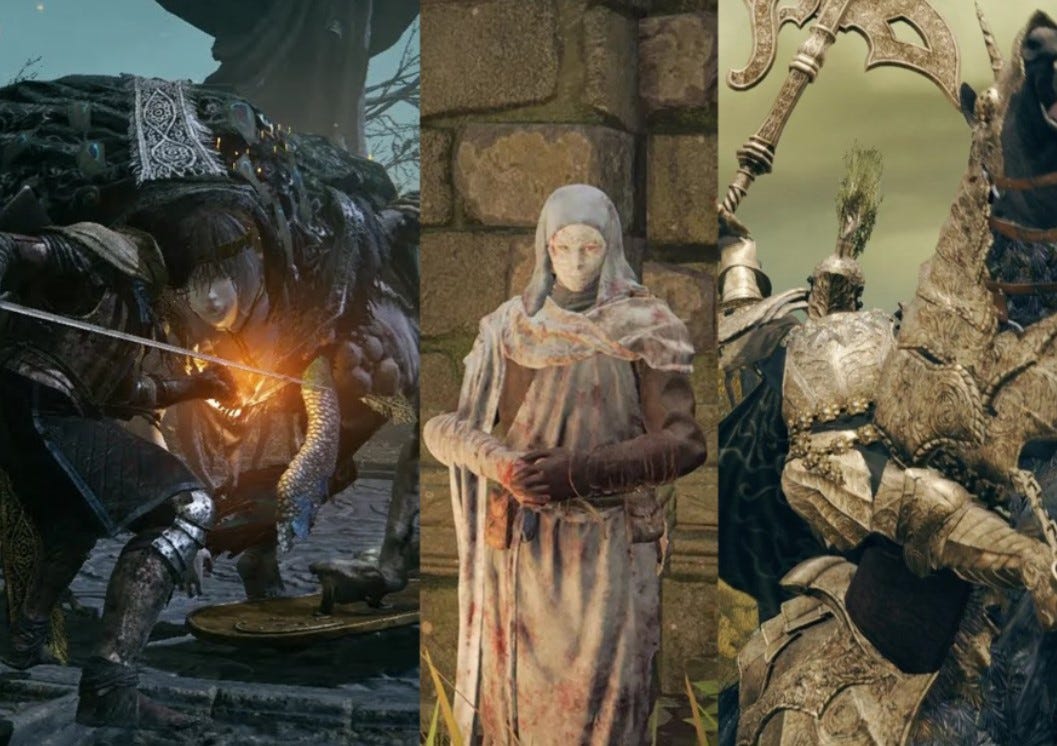
My first hours in the Lands Between were not triumphant. I was killed almost immediately by the Grafted Scion, but because the game carried on, I assumed this was probably meant to happen. Then I made it through the tutorial and defeated the Godrick Soldier without dying, which gave me the dangerous impression that I had understood something. Then I reached Limgrave.
I had not yet seen a non-ghost, non-cutscene NPC. So when I saw White Mask Varré standing there, looking suspicious in the way that almost everyone in Elden Ring looks suspicious, I hit him. This was not, it turned out, the intended social protocol. By the time I realised he was speaking to me rather than preparing to murder me, it was too late. He became extremely committed to the bit. What followed was a long, humiliating cycle in which he killed me, I respawned, and he killed me again. Eventually, through perseverance, luck, and the kind of grim stubbornness that has caused many avoidable disasters throughout human history, I killed him.
Then I met the Tree Sentinel.
This, I thought, was absurd. Why would you put a boss like that at the very beginning of the game? Why give a new player a beautiful open field, a dazzling golden horseman, and then have him flatten them into paste every time they tried to make progress? I put the game down for a few days and considered writing the whole thing off as a bad investment.
Then I discovered something important. You can just go around him.
This sounds embarrassingly obvious now. At the time, it felt like a design revelation. Elden Ring was not asking me to beat everything in front of me. It was asking me to notice what kind of obstacle I was looking at. Some enemies were challenges. Some were warnings. Some were environmental hazards with a health bar. The Tree Sentinel was not a test I had to pass before entering the game. He was part of the game’s grammar.
That distinction matters, because much of the argument about difficulty in Elden Ring collapses several different questions into one.
There is the accessibility question, which is serious and should not be waved away by people whose main contribution to cultural criticism is typing git gud under strangers’ comments. There is the question of whether certain quality-of-life features would make the game more legible without making it less meaningful. I still think the absence of anything resembling a quest log is, at times, less an artistic decision than a practical joke being played on people with jobs. There is the genre question: whether every game should be designed for every player, or whether some games are entitled to a narrower and more demanding form. And then there is the artistic question: what is the difficulty actually doing?
The problem with the difficulty debate is not that one side cares about accessibility and the other cares about artistic integrity. That is too flattering to everyone involved. The problem is that difficulty is often treated as a single substance: either a virtue, proving the game’s seriousness, or a vice, proving its hostility. But difficulty can be many different things. It can be a gatekeeping device. It can be bad tuning. It can be a lack of accessibility options. It can be nostalgia for a more punitive era of game design. It can also be atmosphere, pacing, narrative pressure and worldbuilding.
In Elden Ring, difficulty is not incidental to the experience. It is one of the main ways the world tells you what it is.
The Lands Between are not arranged like a theme park, with appropriately levelled attractions and helpful signs telling you which ride to queue for next. They are broken, ancient, hostile and indifferent. You arrive late, ignorant and underpowered, surrounded by the remains of conflicts you do not understand. The world does not explain itself because, in narrative terms, it has no reason to care whether you understand it. You are not the chosen one arriving at the start of history. You are a Tarnished wandering through the wreckage after the catastrophe has already happened.
A friendlier version of the same game might have preserved the lore, the bosses, the map, the gorgeous melancholy of the setting. It might even have been a very good game. But it would have meant something different. If the Lands Between were scaled around my comfort, if every enemy politely registered my level and adjusted itself accordingly, the world would cease to feel like a place that existed before me and beyond me. It would become a sequence of content.
That is the dullest possible word for what Elden Ring is doing.
Its difficulty forces a different rhythm of attention. You cannot always sprint towards the golden arrow. You cannot assume that the next thing in front of you is the next thing you are meant to defeat. You learn to read terrain. You learn to retreat. You learn that a cave, a ruin, a graveyard or a suspiciously empty patch of land may contain the one weapon, spell, flask upgrade or scrap of knowledge that makes the impossible merely dreadful.
This is why the open world matters. In a more linear game, an early overpowered boss can feel like a brick wall. In Elden Ring, the Tree Sentinel is not a brick wall. He is weather. He is topography. He is a visible statement of principle: this world is not arranged around your entitlement to progress.
That does not mean the game wants you to suffer for suffering’s sake. It is not simply difficult in the manner of an old arcade machine designed to extract another coin from a child with poor impulse control. It is difficult in a way that teaches caution, curiosity and humility. It makes ignorance dangerous, which is thematically appropriate for a game so invested in fragments, ruins, half-truths and buried histories.
This is where the difficulty becomes narrative.
When you spend an hour being murdered by the same boss, you start to notice things. You listen to the same lines of dialogue. You look properly at the arena. You read the item descriptions because, frankly, anything might help. You start asking why an enemy is where they are, what they are guarding, what their design suggests about their place in the world. A sword is not just a sword; it is a clue. A spell is not just a spell; it is a remnant of a school, a faction, a catastrophe. A boss is not just a test of reflexes; it is a piece of environmental storytelling with a murderously large health bar.
This is not unique to Elden Ring, but Elden Ring makes unusually good use of it. Its story is not delivered as a tidy sequence of cutscenes in which characters explain the plot with the patience of museum audio guides. It is scattered. It is half-buried. It is overheard, excavated, inferred. The game’s opacity and its difficulty reinforce each other. You are not just told that the world is ruined and unknowable. You experience it as ruined and unknowable.
There is a risk, of course, of overstating this. Not every frustrating thing in a difficult game is secretly profound. Sometimes a camera is bad. Sometimes a runback is tedious. Sometimes an interface is obscure in the way that an unlabelled fuse box is obscure. The defence of difficulty should not become a theology in which every irritation is revealed as grace.
Nor does defending Elden Ring’s difficulty mean endorsing the tedious machismo that clings to these games. The worst version of Souls fandom talks as if the highest purpose of art is to sort the worthy from the unworthy, preferably while being insufferable to strangers online. That is not an argument. It is a social performance with a dodge-roll button.
A serious defence of difficulty has to be more careful than that. It has to admit that exclusion can be real. It has to distinguish between challenge and inaccessibility, between opacity and carelessness, between meaningful friction and needless inconvenience. It also has to accept that some people will not enjoy this kind of experience, and that their dislike is not a moral failure. A game can be excellent without being hospitable to everyone. A player can bounce off an excellent game without being wrong.
But once those concessions are made, the point still stands. The difficulty of Elden Ring is not just a badge of identity. It is not merely there so that people who completed it can feel superior to people who did not. At its best, it is a form of atmosphere. It gives weight to the world. It makes exploration feel earned. It turns progress into comprehension. It slows the player down enough to notice the story that would otherwise be missed.
I do not think this argument holds for every game. I would not want every RPG to become Elden Ring. There are many games where an easy mode is not only desirable but obviously harmless. There are games where difficulty settings broaden the audience without compromising the work. There are games where the appeal is the story, the characters, the choices, the spectacle, the mood, and the combat is mostly there to give everyone something to do between conversations.
But Elden Ring is not one of those games.
Its difficulty is part of its fiction. It makes the Lands Between feel ancient, dangerous and indifferent. It makes victory feel less like consumption and more like survival. It makes the player inhabit the world’s brokenness, not merely observe it. To make the game easy in the wrong way would not simply lower the challenge. It would change the texture of the place.
That is why my most satisfying moment in Elden Ring was not becoming Elden Lord. It was going back to Limgrave, over-levelled and over-equipped, and reducing the Tree Sentinel to crimson finger-paint with a large hammer.
Petty? Yes. Spiritually limited? Almost certainly. But it meant something because the game had first made him mean something. He was not just the first hard enemy I found. He was the point at which I started to understand what kind of game I was playing.
Elden Ring is not easy. But the point is not that hard games are inherently better, or that players who struggle should be mocked, or that inconvenience is always artistic integrity wearing a funny hat. The point is that, in this particular game, difficulty is one of the ways the world speaks.
It says: you are small.
It says: you do not understand this place yet.
It says: come back later.
And, eventually, if you are patient enough, it lets you answer.