

There are political debates which seem to have been cast by somebody with an unusually heavy hand.
Earlier this month, Tucker Carlson travelled to Jacob Rees-Mogg’s house to discuss Britain, Russia, Ukraine and war. Carlson is, at this point, close to the platonic ideal of the American populist who thinks Europeans are forever trying to persuade young men from Ohio to die for countries they couldn’t locate on a map. Rees-Mogg, meanwhile, looks like a Madeira-soaked ghost summoned from a Napoleonic-era mahogany drinks cabinet specifically to explain the European balance of power.
If you invented these two men for the purpose of staging an argument about whether Britain should have honoured its commitments to Poland in 1939, an editor might reasonably ask you to make them less obvious. And yet this is roughly where their conversation ended up.
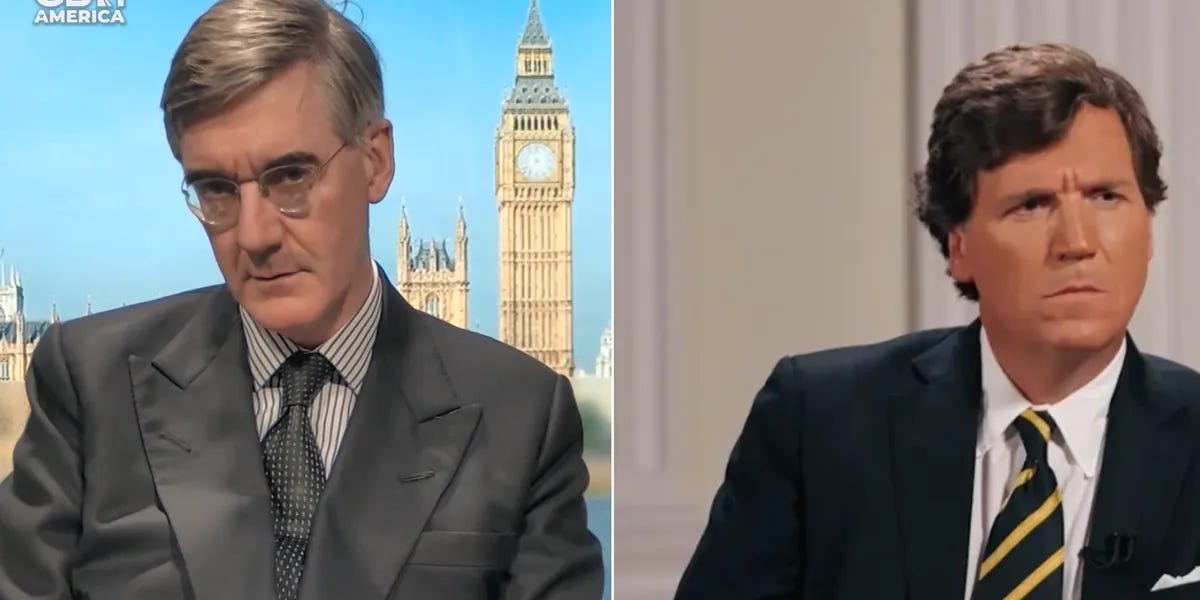
What began as an argument about whether Britain should prepare for possible confrontation with Russia wandered through NATO, nuclear weapons and the morality of Hiroshima, before Carlson began questioning whether Britain had benefited from fighting the Second World War at all. Germany, he pointed out, had lost territory to Poland after the First World War; Hitler’s demands therefore didn’t emerge entirely from nowhere. Britain hadn’t itself been invaded. The war destroyed much of Britain’s wealth and hastened the end of its empire. When Rees-Mogg suggested that otherwise Britons might have ended up speaking German, Carlson’s response was essentially: who cares?
Rees-Mogg, who by this point found himself defending the proposition that defeating Adolf Hitler had been a good idea, eventually accused Carlson of verging on defending Hitler. Carlson sarcastically reassured him that he wasn’t secretly a Nazi.
This is the point at which the easier version of this article writes itself.
You could spend several thousand words explaining why Hitler’s territorial claims weren’t merely an innocent attempt to correct Versailles; why Britain’s interests extended beyond waiting for German troops to arrive in Dover; why an authoritarian racial empire dominating continental Europe might have represented something more serious than a regrettable change in the language curriculum; and why, if your analysis of the Second World War culminates in wondering whether defeating Nazi Germany was worth the trouble, it may be worth checking whether one of the earlier steps has gone awry.
All of which would be enjoyable.
It would also dodge the most interesting part of the argument.
Because underneath Carlson’s provocations there is a serious question. In fact, there are several. Governments have special obligations towards their own citizens. War kills people who had very little say in starting it. Foreign-policy establishments have an impressive record of translating abstractions such as credibility, deterrence and international order into very concrete deaths. Nuclear powers really can escalate beyond anybody’s control, at least in theory. States really do have security interests within and beyond their borders, whether or not we consider those interests morally attractive. And somebody advocating war should be able to explain to the parents of the person being sent to fight why their child’s death might be worth it.
Carlson asks that question repeatedly.
We should answer it.
A better Tucker Carlson
So, for the next few paragraphs, I’m going to do Tucker Carlson a favour.
I’m going to construct a better version of his argument than he sometimes constructs himself.
The steelman goes something like this.
The first duty of a government is to the people it governs. That doesn’t mean foreigners possess no moral value, nor that atrocities abroad are irrelevant, but moral concern doesn’t automatically generate obligation. There are terrible things happening in the world at almost any given moment, and no country has the capacity (or the right, if you accept the principle of statehood being the right to govern according to that state’s own policies) to correct all of them by force.
War therefore requires a higher threshold than something bad is happening.
The question is not merely whether Russia was wrong to invade Ukraine. It plainly was. The question is what British or American interest justifies imposing the costs of resisting that invasion upon British or American citizens.
Even short of the hypothetical future position with boots on the ground in Kyiv, those costs aren’t imaginary. Weapons cost money. Rearmament diverts resources. Sanctions have consequences. Escalation creates risks. And yes, at the outer edge of the argument sits the possibility of direct war between nuclear-armed states, in which the phrase defending the international order could acquire rather more apocalyptic content than the people using it intended.
Nor should we dismiss the security interests of adversaries simply because they’re adversaries. Russia predictably dislikes an American-led military alliance expanding towards its borders, whether that expansion is intentional or otherwise. China, similarly, predictably dislikes American military power operating off its coast. A sensible foreign policy deals with the world as it exists rather than assuming every other state will eventually recognise the benevolence of Western intentions.
And history should make us suspicious of people who insist that the next foreign war is indispensable. Vietnam was indispensable until it wasn’t. Iraq was about weapons of mass destruction until there weren’t any. Afghanistan acquired objectives rather faster than it achieved them. Libya was supposed to prevent a massacre and ended in state collapse.
There is something morally attractive about demanding a simple answer before adding another country to the list.
What, precisely, are you asking our people to die for?
Carlson is also at his strongest when he reminds Rees-Mogg that winning a war doesn’t automatically justify everything done in its prosecution. Their exchange about Hiroshima and Nagasaki is illuminating partly because Rees-Mogg’s defence is so weak. Carlson asks whether killing innocent civilians becomes morally permissible because doing so shortens a war. Rees-Mogg effectively says yes; Carlson responds that this rather misses the Christian just-war principle Rees-Mogg is invoking.
Carlson’s wider historical argument may be poor, but the moral instinct here isn’t.
A government contemplating war owes its citizens an explanation. It owes foreigners moral consideration too. It owes both some account of proportionality. And the fact that an adversary has behaved wickedly doesn’t absolve us of responsibility for what we subsequently choose to do.
All of this survives the steelman.
The trouble starts when Carlson asks only one side of the question.
The cemetery problem
Suppose I’m trying to decide, in retrospect, whether Britain should have entered a war - World War I, to be specific, as Carlson briefly asks Rees-Mogg. On one side of the ledger, I can place the people who actually died: I can visit the graveyards, count the names on village memorials, calculate the debt, photograph the ruins, find the letters sent home and look, as Carlson invites Rees-Mogg to do, at the names of boys from Eton killed during the First World War, before asking what cause could possibly have been worth their lives.
That side of the ledger is horribly real.
The other side is harder, because there is no cemetery for people who died in the history which didn’t happen. We cannot count the countries which might have disappeared because an aggressor concluded that nobody would stop it, nor the wars which might have become necessary ten years later because one wasn’t risked before; equally, we cannot see the invasions which never occurred because an adversary expected resistance, or the states which remained peaceful because their neighbours believed an alliance was credible.
Counterfactual casualties, including the casualties avoided by successful deterrence, therefore suffer from a serious presentational disadvantage: they don’t have parents to put on television.
This creates what I think of as counterfactual asymmetry. Carlson compares the known costs of intervention with the imagined costs of non-intervention, and because only one of those histories actually happened, one side of the comparison arrives conveniently itemised. The First World War killed hundreds of thousands of Britons; we know their names. The Europe which would have existed had Britain remained neutral doesn’t exist; its costs can therefore be assigned any value we like, including zero.
This doesn’t mean intervention is always correct. It means, as was stated by John Spencer’s Leo McGarry in The West Wing, that “we don’t always know how it ends!” It means the choice is almost never properly described as war versus peace. It is a choice between the world produced by intervention and the world produced by non-intervention, neither of which can be known in advance.
Which brings us, somewhat reluctantly, to Belgium.
What did Belgium ever do for us?
Carlson and Rees-Mogg both treat the First World War as rather more morally complicated than the Second, which in retrospect is obviously true. The problem lies in the phrase in retrospect.
The statesmen making the decision in August 1914 didn’t possess our retrospective categories. They weren’t offered a menu containing the First World War, complete with the Somme, Passchendaele, hundreds of thousands of British dead, imperial collapse and the political conditions from which Hitler would later emerge, alongside a second option in which everyone simply went home. They faced a different decision.
Germany had demanded passage through neutral Belgium as part of its plan for defeating France; Belgium refused; German troops entered anyway. Britain was among the powers which had guaranteed Belgian neutrality, although precisely what military action that nineteenth-century guarantee compelled remained contested. France faced possible defeat, and British policymakers had to consider what Europe might look like if Germany emerged dominant across Belgium and France.
We don’t have to reconstruct this argument from hindsight because Edward Grey made it at the time. Speaking to the Commons on 3 August 1914, Grey explicitly asked MPs to imagine Britain remaining neutral while France was defeated and Belgium, perhaps Holland, and the western coast opposite Britain fell under the domination of a single power. Neutrality, he argued, wouldn’t insulate Britain from the economic or strategic consequences of such an outcome, while reneging on Britain’s position towards Belgium would destroy its reputation as well.
Whatever we now think of Grey’s judgement, he wasn’t simply sleepwalking into war because Britain had accumulated some diplomatic paperwork. He was asking the counterfactual question Carlson tends to skip: what happens if we don’t?
Perhaps Grey was wrong. Perhaps Britain could have remained outside the war, conserved its wealth, accommodated a German-dominated continent; perhaps German power would eventually have moderated, France would have survived intact, or Britain could have intervened later under more favourable circumstances. All of these belong to the set of histories which didn’t happen, and that is precisely the point: one cannot point to the actual dead of 1914 to 1918 and treat their existence as proof that one of those alternatives must have been benign.
Carlson asks whether a British mother could be told her son died for a good cause protecting Belgium. It is an uncomfortable question, but the equally uncomfortable question is what Britain’s guarantee of Belgian neutrality would have meant if the answer, once Belgium was actually invaded, had been that protecting Belgium was too dangerous. A promise to defend somebody only until defending them becomes costly is not, on inspection, one of diplomacy’s stronger deterrent formulations.
Why die for Danzig?
Twenty-five years later, somebody asked Carlson’s question rather more elegantly. On 4 May 1939, the French politician and journalist Marcel Déat published an editorial in L’Œuvre under the title Mourir pour Dantzig?, asking why French citizens should risk their lives over a remote territorial dispute whose immediate object was the Free City of Danzig.
Déat’s later collaboration with Nazi Germany is an arresting biographical detail (perhaps paralleled by the criticisms of Tucker which imply he is too close to the Kremlin?), but it shouldn’t be allowed to do the intellectual work for us. Bad people can ask good questions, and the argument he advanced in May 1939 deserves to be considered on its own terms precisely because it wasn’t simply a declaration that Poland should be abandoned whatever happened. His point was narrower: France should defend its own security and could fight alongside Poland where their common interests genuinely required it, but allowing the life of a French conscript to turn upon every decision made in Warsaw seemed an altogether different proposition.
The resemblance to Carlson is hard to miss. Why should a French peasant die for a city on the Baltic; why should a Briton take serious risks over the Donbas; or, perhaps, why should an American sailor die defending Taiwan? Asked at that level, the question has considerable emotional force because there are remarkably few pieces of foreign geography which, considered solely as pieces of geography, look commensurate with a human life. Picking a hill to die on seems small and stupid, as in the aphorism, because it’s just a hill.
The difficulty is that states don’t experience history at that resolution. Danzig didn’t arrive in a sealed container, detached from everything which had happened before it. Germany had remilitarised the Rhineland, annexed Austria, acquired the Sudetenland following Munich and then occupied the remainder of the Czech lands in March 1939, thereby demonstrating that the previous territorial demand hadn’t represented the final correction of an unfortunate border. By the time Hitler’s pressure shifted towards Danzig and the Polish corridor, British and French leaders weren’t being asked merely whether one Baltic city was worth a European war; they were being asked whether the pattern through which German territorial claims had repeatedly expanded could still be treated as a succession of isolated grievances.
What makes the problem difficult is that each individual claim contained enough plausibility to support a case for restraint. Austria was overwhelmingly German-speaking; Sudeten Germans had genuine grievances; Versailles had produced awkward borders; Danzig itself was overwhelmingly German; and, above all, another European war threatened consequences far worse than conceding to any one demand. Appeasement therefore wasn’t absurd because its advocates had somehow failed to notice that Hitler was unpleasant. They remembered 1914, they knew Britain and France were militarily weaker than they wished to be, they were attempting to buy time, and they were conscious that some aspects of the post-war settlement really were difficult to defend.
The strategic problem lay elsewhere. If every individual demand is cheaper to concede than to resist, an expansionist power can proceed incrementally until the accumulated settlement is far worse than any of its separate components. There is no single slice of salami worth a war; the difficulty arrives when somebody finally notices that the whole sausage has been devoured.
That is why Why die for Danzig? is simultaneously such a humane and such an incomplete question. It invites us to compare one human life with one foreign city, rather than asking what the city has temporarily come to represent within a sequence of commitments, previous concessions and expectations about the future. Nothing in that observation proves that Britain and France were necessarily correct to draw the line where they did, and still less that every later crisis should be turned into 1939 by analogy. It does mean, however, that a foreign-policy doctrine which assesses each demand entirely on its immediate merits risks missing the cumulative process through which the strategic environment itself changes.
There is an additional awkwardness here, because deterrence is at its least politically impressive when it works. Nobody remembers the Luxembourg Crisis of 1867 because France and Prussia were deterred from conflict by Britain, and the tension peacefully resolved by treaty. Had Britain and France drawn a credible line somewhere earlier in the arc of history leading to the Second World War - say, opposing the remilitarisation of the Rhineland - and had Hitler consequently backed down, a later critic could easily have asked what the fuss had been about. Germany never invaded; nobody died; apparently nervous statesmen manufactured a crisis over territory which, in the event, remained peaceful. The evidence that deterrence had been necessary would be the event which didn’t occur, which returns us to the cemetery problem with the perversity of international relations intact.
Taiwan, before the history books arrive
Taiwan gives us a particularly useful contemporary test because history hasn’t yet selected the branch. Unlike Ukraine, where policy is already being made in response to an invasion which has happened, American policy towards Taiwan is principally concerned with shaping the calculations which precede an invasion, which means that the entire argument takes place in the uncertain territory between reassurance, deterrence and provocation.
The United States doesn’t possess a simple treaty commitment requiring it to defend Taiwan. Instead, the Taiwan Relations Act commits Washington to supplying Taiwan with defensive capacity and to maintaining the American ability to resist coercion, while leaving deliberately unclear exactly what the United States would do if China attacked. Strategic ambiguity is therefore an odd doctrine by design: China isn’t meant to know with certainty whether America would fight, Taiwan isn’t meant to know with certainty either, and everyone involved spends considerable sums preparing for a decision nobody is supposed to make in advance.
Yet the very strangeness of that arrangement exposes the weakness of a simple not our war principle. Suppose Beijing announced tomorrow that unification by force had become unavoidable. An American decision not to intervene could be defended with arguments Carlson would immediately recognise: Taiwan isn’t American territory; China is a nuclear-armed great power with obvious interests immediately off its coast; a war between the United States and China could be catastrophically destructive; and risking Los Angeles or Honolulu for Taipei would require an extraordinary justification.
Those considerations are serious enough that I don’t propose to answer the question here. The more revealing exercise is to move it backwards. If Washington knows in advance that it would never defend Taiwan, should it say so clearly, as Carlson wants to? Doing so might reassure China about the limits of American ambition in its ‘Sphere’ and remove one source of strategic uncertainty, but it would also alter Beijing’s estimate of the costs of using force. Perhaps, then, Washington should maintain the capability to intervene without promising that it will, so that China cannot safely assume an attack would remain a bilateral affair.
At which point we have, more or less, reinvented strategic ambiguity.
The deeper problem is that Carlson is willing to trace one causal mechanism much more readily than its inverse. He is attentive to the possibility that NATO expansion can provoke Russia, that American military deployments can alarm China, and that sending weapons into an active conflict can contribute to escalation; none of those propositions is inherently foolish. Yet retreat, ambiguity and weakness also enter other governments’ calculations, which means that restraint cannot be treated as the simple absence of an action. Withdrawal communicates information, unreliable guarantees alter incentives, and a state which no longer believes its ally will come may accommodate a stronger neighbour, seek another patron, or decide that only its own nuclear weapon can provide the security it needs.
This is why deterrence looks provocative before aggression occurs, while intervention can look unnecessary after deterrence fails, and withdrawal looks peaceful until somebody takes advantage of it. The problem isn’t that one of those descriptions is always wrong; it is that any doctrine capable of seeing only the dangers created by action, while discounting those created by anticipated inaction, has built the answer into its premises.
Taiwan therefore shows that Why die for Taiwan? cannot settle the matter, because the answer to that question also affects whether anybody is ever required to die for Taiwan in the first place.
Spheres for me, sovereignty for thee
There is a second asymmetry buried inside Carlson’s realism, and it becomes clearer once we move from the behaviour of great powers to the behaviour of the smaller states around them. Carlson is quite right that Russia and China possess security concerns which cannot simply be wished away: Russia predictably dislikes the expansion of an American-led military alliance towards its borders, while China predictably dislikes American military power operating in East Asia and regards Taiwan as central to its own national story.
Any diplomatic strategy which refuses to understand those perceptions because Moscow and Beijing are adversaries will be poorer for it. The problem comes when understanding shades into privileging. If Russian fears about NATO count as structural realities which the West has an obligation to accommodate, then Polish, Baltic and Ukrainian fears about Russia must surely count as structural realities too; if China’s desire to prevent an American military presence close to its coastline is intelligible, then Taiwan’s desire not to be forcibly absorbed by a vastly more powerful neighbour is intelligible for precisely the same reason.
Carlson’s version of realism often seems to perform only the first half of this exercise. The security anxieties of great powers appear as facts of geography and history, while the anxieties of weaker states appear as unfortunate complications produced by their attachment to rival powers. Poland’s desire for NATO becomes evidence of Western encroachment rather than an equally predictable response to Polish history; Ukraine’s effort to escape Russian domination becomes something the West has manipulated rather than something Ukrainians might independently desire.
The descriptive proposition that great powers seek spheres of influence is difficult to dispute. The normative conclusion which sometimes follows, that smaller countries should therefore accept those spheres because resisting them is dangerous, is something else entirely. At that point sovereignty begins to mean that weak states may choose their futures provided no sufficiently powerful neighbour finds the choice inconvenient.
There is a strange contradiction here for a political worldview so attached to the nation state. Carlson’s argument repeatedly asks us to take Russian and Chinese national interests seriously, while treating Ukrainian or Taiwanese national interests as subordinate to the realities imposed by geography. Rees-Mogg, despite having the general appearance of a man who might still regard the Congress of Vienna as breaking news, ends up defending the more modern principle: that small nation states possess agency too, and that joining an alliance can itself be understood as an expression of sovereignty rather than evidence that sovereignty has disappeared.
That doesn’t mean every alliance choice made by a smaller state imposes an obligation upon everybody else to defend it. Ukraine’s right to seek NATO membership and Britain’s obligation to accept Ukraine into NATO are different questions, just as Taiwan’s right to remain self-governing and America’s obligation to fight for it are different questions. What it does mean is that a serious realism should apply its realism consistently. Geography constrains the small as well as the large; security fears exist in Warsaw as well as Moscow; and a theory which treats only the preferences of the strongest actor as immovable facts risks redescribing power as legitimacy.
Unfortunately, Kant
At this point, having begun with Tucker Carlson interviewing Jacob Rees-Mogg, we have somehow arrived at Immanuel Kant. I accept responsibility for this, although in my defence Carlson is the one who started discussing first principles.
The temptation here is to produce a vaguely Kantian argument which says that bad consequences would follow if everybody minded their own business, but that isn’t quite enough. The more interesting question concerns the maxim behind Carlson’s position and whether the institutions from which states benefit could continue to exist if everybody acted upon it.
Suppose the rule were that a state should never expose its citizens to serious cost or danger in defence of another state unless its own territory faces an immediate threat. As a principle of restraint it sounds attractive, particularly because it recognises that governments have special obligations towards the people whose lives they can actually command. Yet if every member of an alliance applies the same rule, the nature of the alliance begins to change. A security guarantee is valuable precisely because an aggressor expects it to survive the moment at which honouring it becomes costly; a guarantee which disappears whenever enforcement becomes dangerous is less a deterrent than an expression of sympathy.
Article 5 of the North Atlantic Treaty could, under the strongest version of the Carlson Doctrine, be substantially shortened: an attack upon one shall be considered an attack upon one.
The joke works because the contradiction is structural. The problem isn’t merely that universal non-intervention produces outcomes we dislike; it is that the benefits Carlson’s America enjoys from alliances depend upon enough other countries refusing to apply the principle consistently. A country can benefit from an expectation of reciprocal defence while reserving the right to treat every test of that expectation as somebody else’s problem, but only for as long as its partners don’t behave the same way.
This is close to the logic in Kant’s example of the false promise. The liar can benefit from promising to repay money because the institution of promising still carries credibility; if everyone understands promises to be meaningless whenever keeping them becomes inconvenient, the practice which makes the lie useful begins to collapse. Something similar happens with collective security. Britain benefits from treaties which adversaries expect Britain to honour, America benefits from allies believing American guarantees, and every NATO member benefits from the assumption that attacking a small Baltic state isn’t simply a bilateral quarrel between that state and Russia.
None of this establishes the opposite maxim, according to which every state must fight whenever another state is wronged. Universal intervention would be morally reckless and practically impossible, and if the only alternatives available were crusading liberal internationalism or complete indifference, Carlson would have a much stronger case.
The more plausible principle is also, inevitably, less exciting: states may sometimes accept proportionate costs and risks in order to sustain alliances, guarantees and rules whose continued credibility contributes to their own security, while retaining an obligation to judge particular interventions too costly, too dangerous or too remote from any defensible national interest. Nobody is likely to embroider that on a regimental flag, but foreign policy has rarely rewarded brevity.
What this gives us is restraint without converting restraint into indifference. It allows us to say that the danger of nuclear escalation constrains what Britain should do in Ukraine without concluding that Ukraine’s fate is irrelevant; it allows us to defend NATO without supposing NATO should expand without limit; and, crucially, it allows a doctrine which supports collective security in one case to reject a discretionary war in another.
Which brings us back across the Atlantic.
Why die for Washington?
For most of the Cold War, the foundational proposition behind NATO was that an attack upon Western Europe could eventually bring Americans across the Atlantic to fight. If Soviet forces moved into West Germany, American soldiers might die, not because Frankfurt had somehow become American territory, nor because the Fulda Gap possessed a mystical claim upon young men from Pennsylvania, but because successive American governments had concluded that preventing Soviet domination of Western Europe formed part of America’s own security, and that making this commitment credible in advance reduced the likelihood that it would ever have to be fulfilled.
This worked, by the way. The Berlin Wall fell, and the Soviet Union collapsed, without a war in Western Europe, without a nuclear weapon being fired, indeed without any direct military confrontation between the USA and USSR.
Then, on 11 September 2001, the United States itself was attacked, and on the following day NATO invoked the principle of Article 5 for the first time in its history. The direction of the guarantee reversed: an alliance created largely to reassure Europeans that America would come if they were attacked was now being asked what Europeans would do when America had been attacked instead.
This gives us a counterfactual which is deliberately uncomfortable. Imagine European governments applying the strongest version of Carlson’s principle on 12 September 2001. Why should a British soldier risk his life because terrorists attacked New York? Why should a Canadian die because an aeroplane hit the Pentagon? Afghanistan was thousands of miles away, the Taliban posed no conventional threat of invading Britain, and American foreign policy had unquestionably contributed to hostility towards the United States in parts of the Middle East. Military involvement might provoke terrorism against European cities, while any attempt to remake Afghanistan could embroil allied countries in a conflict whose objectives gradually expanded beyond the immediate response to al-Qaeda.
Every one of those considerations contains the beginning of a serious argument. Taken together as a reason why the attack was simply none of Europe’s concern, however, they feel strangely inadequate.
Why die for DC?
The formulation is intentionally ugly because, for many readers, the historical distance which cushions Why die for Danzig? disappears. The foreign capital is now familiar, the dead have photographs, and the state asking its allies whether their promises mean anything is the United States itself.
That doesn’t mean British or Canadian soldiers subsequently acquired an unlimited obligation to participate in whatever Washington chose to call part of the response to terrorism. Indeed, the years after 9/11 demonstrate why the distinction is indispensable. Afghanistan could be defended initially as a response to the organisation responsible for the attacks and the regime sheltering it, while still becoming strategically incoherent as the mission expanded; Iraq, by contrast, shouldn’t be smuggled into the moral authority of Article 5 at all. The invasion of 2003 remains one of the strongest arguments for scepticism towards foreign-policy establishments which claim that distant threats must be confronted before they reach us.
The lesson is therefore not that solidarity after 9/11 vindicates intervention elsewhere. It is that America itself has depended upon other countries refusing to define national interest so narrowly that any attack beyond their own borders automatically belongs to somebody else.
The reciprocal question is what gives the argument its force. Carlson asks, quite reasonably, what Americans or Britons owe to foreigners; any principle which claims to govern international relations must also be capable of answering what Americans and Britons are entitled to expect foreigners to owe them. A country which wishes to benefit from alliances, forward defence and collective deterrence cannot coherently regard the burden of maintaining those institutions as an imposition only when it falls upon itself.
That is the categorical imperative with some blood in its veins. The question is no longer merely whether I would prefer to avoid the costs of somebody else’s crisis, but whether I could rationally will a system in which everyone adopted the same rule when the crisis happened to be mine.
The trouble with minding our own business
Carlson’s strongest argument therefore survives rather more of this essay than his weakest remarks about the Second World War might suggest. Governments should be extremely reluctant to spend the lives of their citizens; injustice abroad doesn’t automatically generate a duty to intervene; nuclear weapons impose serious constraints upon what prudence allows; adversaries possess fears and interests which don’t disappear because their governments are unpleasant; diplomacy sometimes requires compromise; and a political culture which rediscovers Munich every time negotiations are proposed is perfectly capable of leading itself into disaster.
There are wars which aren’t ours. There must be.
The mistake is to imagine that restraint can be identified simply by asking whether the threatened territory belongs to us, because states act within systems of repeated interaction in which intervention and non-intervention both alter the environment in which the next decision will be made. Arming Ukraine can prolong fighting; refusing to arm Ukraine can change Moscow’s expectations about the profitability of aggression. Extending a guarantee can create escalation risks; allowing guarantees to become incredible can create different escalation risks. A visible military deployment can frighten an adversary; a visible withdrawal can encourage one.
Minding our own business is therefore not an absence of foreign policy. It is a foreign policy, and other countries are allowed to notice it.
This is the deeper weakness in Why die for Danzig? The question places one French life on one side of the scales and one foreign city on the other, after which the answer is practically contained in the comparison. Yet Danzig wasn’t valuable because of some intrinsic quality of Baltic masonry, lovely though it is; it had become the place at which a wider set of questions happened to become concrete. Did previous agreements impose obligations? Could Germany continue revising borders through threats and force? Was the latest demand likely to be the last? Would another concession reduce the probability of war, or merely change the circumstances under which war eventually occurred?
The same structure appears, imperfectly and with very different legal obligations, in Taiwan. An American sailor wouldn’t be fighting because Taipei possesses some mystical claim upon Nebraska; the relevant calculation would include deterrence, regional balances of power, the credibility of American alliances, the behaviour of Japan and South Korea, the possibility of nuclear proliferation and the consequences of allowing a major power to annex a self-governing neighbour by force. None of those considerations automatically outweighs the risk of a US-China war, but excluding them because Taiwan isn’t America would be an extraordinarily thin definition of American interest.
And the same logic, running in the opposite direction, explains why British, Canadian and other allied governments didn’t treat the attacks of 11 September as a private American tragedy. Manhattan wasn’t British soil. The Pentagon wasn’t in Ontario. Yet the alliance had been built on a prior judgement that some threats to another member were connected to one’s own security strongly enough that the distinction between their problem and our problem couldn’t always be drawn at the water’s edge.
The purpose of collective security, at its most simple and most defensible, is precisely to make somebody else’s war your problem before your problem becomes somebody else’s war.
That proposition can itself become dangerous if treated as a blank cheque. It doesn’t tell us how many weapons to send to Ukraine, whether Ukraine should join NATO, whether America should fight for Taiwan, what level of defence spending Britain requires, or where the danger of escalation exceeds the value of deterrence. Those questions remain questions of judgement, and any doctrine which pretends to answer them automatically is probably hiding its politics inside its premises.
Carlson is right, therefore, to demand that somebody answer the human question before proposing war: why should our people die for this? A government which cannot answer deserves suspicion. Where his argument becomes myopic is in assuming that this refers only to the particular patch of territory currently under dispute, as though foreign policy were a succession of disconnected transactions and the only consequences worth counting were those immediately visible.
Sometimes the thing being defended is indeed too remote, the obligation too weak, the objective too vague or the risk too great. Sometimes a government should look at an ally, a threatened state or an international rule and decide that none of them justifies what intervention would cost. If that possibility disappears, then we haven’t answered Carlson so much as proved his point about interventionists.
But sometimes the thing being purchased is larger than the place where the bill happens to arrive: an alliance whose credibility deters future attacks; a balance of power which prevents a hostile state from dominating its neighbours; a reciprocal expectation that allies won’t abandon one another whenever solidarity becomes expensive; a norm against territorial conquest; or simply the possibility that demonstrating a willingness to resist today reduces the chance that anybody will have to fight tomorrow.
Those things aren’t sacred. They aren’t priceless. They can be badly designed, recklessly extended, cynically invoked and catastrophically misapplied.
They are nevertheless real.
Which means Why die for Danzig? remains a good question, just not a complete one. It forces the advocate of intervention to account for the human cost, and no serious foreign policy should resent being made to do that.
The trouble begins when we mistake the question for the answer.