

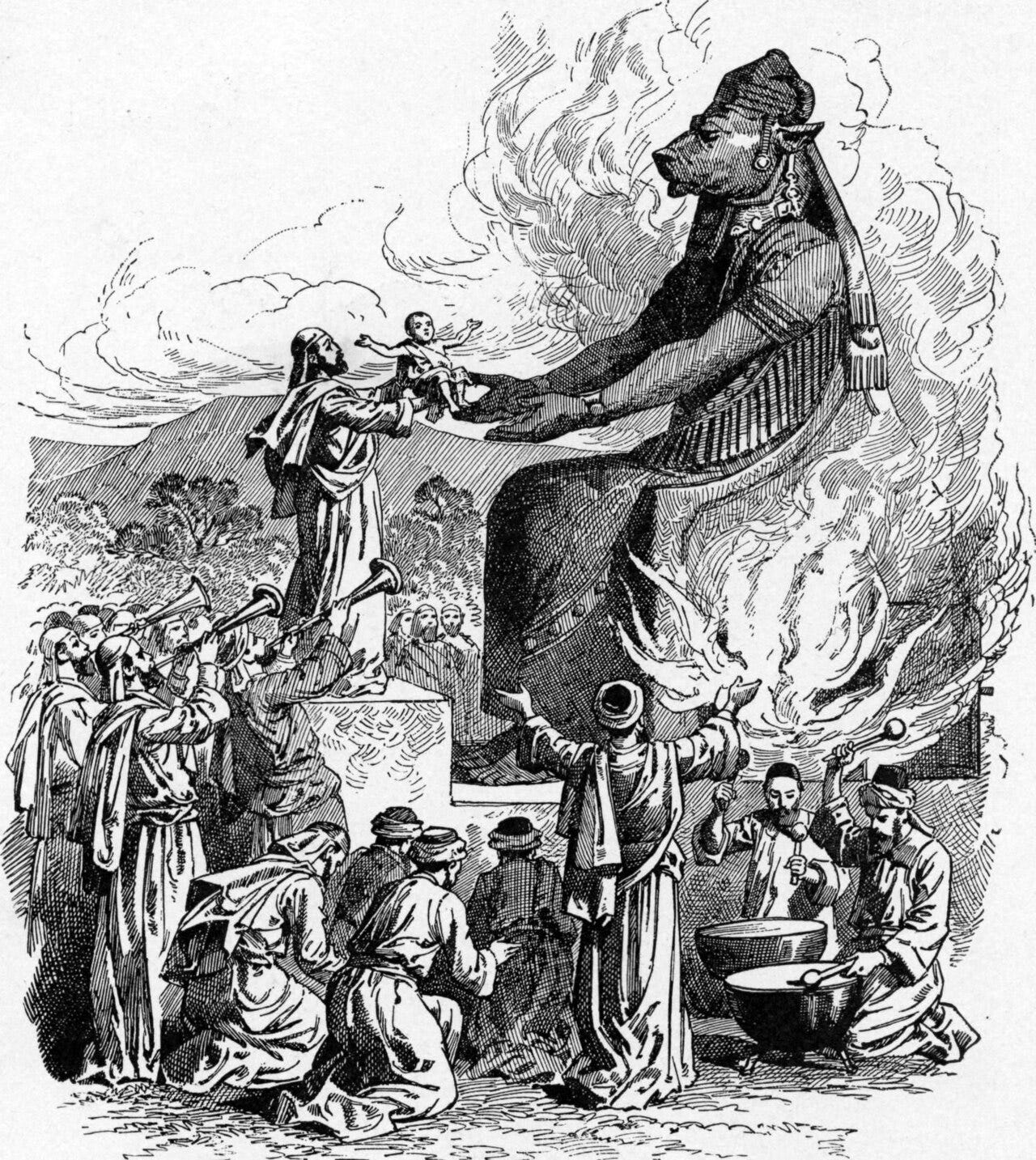
There may never have been an actual god called Moloch.
That claim isn’t settled, I hasten to add. The Hebrew Bible repeatedly condemns the giving of children to Moloch, which generations of readers have understood as the name of a foreign deity who received human sacrifices. John Milton later placed Moloch among the fallen angels of Paradise Lost; Fritz Lang turned the industrial machine of Metropolis into his furnace; Allen Ginsberg found him in the factories, armies, money and loveless machinery of modern America. By the time Scott Alexander published his seminal Meditations on Moloch in 2014, Moloch had become the embodiment of every system that consumes what human beings value while promising them power in return. He even made pop-culture appearances, in Buffy, Stargate, and Supernatural, as a demon or deity of varying kinds.
Yet there’s another interpretation. Beginning particularly with the work of Otto Eissfeldt in 1935, scholars have argued that the Semitic term MLK may originally have referred not to the recipient of a sacrifice, but more properly to the kind of sacrifice performed. Punic inscriptions describe MLK offerings made to named gods such as Baal Hammon and Tanit, and on this reading, the biblical injunction may not have meant that a child was given to a specific god called Moloch, but that the child was given as a moloch: a particular form of offering. Other scholars continue to defend the existence of a deity, perhaps an underworld god or a title applied to several gods. The evidence remains disputed.
I’m highlighting this debate not because it’s an antiquarian curiosity (though that is also true). Far from it: it suggests a different way of understanding Alexander’s Moloch, and perhaps a different way of resisting him.
What if Moloch wasn’t the god above the altar? What if, rather than the gigantic, bronze, bull-headed idol, Moloch was the name of what people did - and do - upon it?
The god who offers power
Alexander begins his now famous essay with a problem which is both simple and profound. Human beings repeatedly produce social arrangements that almost nobody would choose, yet which nobody within the arrangement can safely abandon. Competing businesses degrade working conditions because any firm that pays substantially more may be undercut. States acquire weapons, armies, and the organised capacity for ever-greater violence because unilateral disarmament would leave them vulnerable. Publishers produce sensational material because sober restraint loses attention to less scrupulous competitors. Nobody needs to desire the final outcome - individually defensible actions can still converge upon collective disaster.
Alexander calls these arrangements multipolar traps. From outside the system, cooperation may be obviously preferable, but from within it, the first person to cooperate may simply be exploited. The problem isn’t necessarily ignorance, malice or greed. It’s that restraint carries a cost, while defection is rewarded quickly enough that the more ethical actor may disappear before their example can spread.
This is the great strength of Meditations on Moloch. Political argument frequently assumes that bad conditions must have been produced by bad people. Alexander explains why decent people, following intelligible incentives, may, can, and often do reproduce conditions which they themselves detest. It isn’t enough to tell an employer to be kinder when kindness threatens bankruptcy; nor is it enough to tell a state to trust its rivals when misplaced trust may be fatal. Moral exhortation can’t substitute for institutions which make moral conduct survivable.
In this paradigm, Moloch names the distance between the world that nearly everyone would prefer and the world that competitive pressures allow them to build and live in. And so we’re all trapped in the world where we’re giving ourselves painful electric shocks all the time rather than the entirely-within-our-grasp mini-utopia in which every country spends a lot more on infrastructure and a lot less on defence.
The metaphor is powerful because the ancient bargain is powerfully suited to the mechanism. Alexander’s Moloch always offers the same exchange: surrender what you love, and receive strength enough to defeat those of your opponents who haven’t (yet) made the sacrifice. Once one participant accepts, everyone else is implicitly confronted with the same bargain. Eventually all have surrendered the valuable thing, no-one retains the advantage against their competitors, and the cycle begins again, but from a poorer starting point. What’s the next thing they love, to toss into the flames, to buy just a little bit more strength?
Yet there’s a danger in the metaphor’s very power. The god-image which clarifies the system can also conceal the people who sustain it.
From practice to deity
Alexander knows that Moloch isn’t literally a supernatural being. His examples concern incentives, selection pressures, evolutionary processes and failures of coordination. Nor does he claim that all coordination is impossible; governments, technologies and social institutions can sometimes bind destructive competition, although those coordinating institutions may develop traps of their own.
Nevertheless, the grammar of the essay repeatedly carries him beyond this analytical caution. Moloch ceases to be a name for things people do under particular conditions and becomes the answer to the question of who is doing this to us. Moloch designs traps. Moloch offers bargains. Moloch grinds down human values. Moloch rules the universe.
By the end, Alexander’s analysis has developed into something close to a secular theology. Against Moloch and the uncaring forces of competitive optimisation stands Elua, a tentative Jacqueline Carey-inspired god of love, beauty, art, and civilisation. Between them lies the garden: a protected space within which human beings can cultivate their own values instead of obeying the law of the jungle. Yet because any local garden remains vulnerable to less restrained competitors beyond its walls, Alexander concludes that human values ultimately require a Gardener powerful enough to govern the whole universe. A sufficiently advanced intelligence might finally defeat Moloch by coordinating everything.
It’s an extraordinary conclusion. A compelling description of collective-action problems gradually becomes an eschatology in which fallen humanity must help to lift a new god to heaven, creating the benevolent intelligence that will redeem creation from its inhuman ruler.
The historical ambiguity surrounding Moloch allows us to reverse that movement. What changes when we turn the god back into a sacrifice?
Who is on the altar?
Once Moloch is understood once again as a practice rather than an agent, different questions become foregrounded.
Who is making the offering?
What are they sacrificing?
What advantage do they expect to obtain, and indeed who receives that advantage?
Most importantly, is the person deciding that the sacrifice is necessary also the person placed upon the altar?
These questions expose a weakness in the general category of the multipolar trap. Some destructive systems are genuinely symmetrical, like our contrived electric-shock-country - every participant would prefer an enforceable agreement, but none can risk acting alone.
But many many other systems contain actors who clearly benefit from the apparent failure… and therefore have little desire to coordinate their way out of it.
Consider an organisation which responds to financial pressure by cutting the pay and increasing the workload of its least powerful employees - much like Alexander’s fifth example. It may be true that senior managers face real competitive constraints and are thus limited in the decisions they can make. They may even feel bad about the decision. But it doesn’t follow that the burden has been allocated impersonally. The organisation could reduce executive remuneration to support its workers, accept lower profits as the cost of doing the right thing (and make that virtue a part of their marketing strategy, as many businesses do), change its business model, seek collective regulation or withdraw from the market. Perhaps none of these alternatives are easy; perhaps some are genuinely unavailable in the specific context. Nevertheless, someone still interprets the constraint and decides whose interests are negotiable; someone chooses the child to place upon the altar, rather than laying themselves down in Moloch’s arms.
In other words, Moloch doesn’t select the victim. People do.
The same is true of institutions which organise themselves around crude performance measures. A university may well discover that publications, grants and student evaluations are easier to count than thoughtfulness, intellectual courage, pastoral care or genuine educational transformation. Nobody needs to believe in their heart of hearts that the metric captures everything valuable. Yet recruitment, promotion and funding decisions begin to reward whatever the metric recognises. Academics adapt rationally; departments encourage them to adapt; the measure becomes increasingly important because everybody behaves as though it is important.
This is recognisably Molochian, in that individual refusal may damage a career without changing the institution. Yet the metric didn’t descend from the heavens. It was selected, implemented, retained, and reinforced over time. The system exerts emergent pressure, but that pressure travels through a socio-material web of meetings, zoom calls, policy documents, regulations, budgets and decisions, decisions, decisions. The rite of Moloch does not perform itself; it has priests, liturgies and an altar.
To describe the outcome only as a coordination failure risks making everyone equally helpless. They clearly aren’t. Some people design the measure; others are measured by it. Some can absorb the cost of dissent; others can’t. Some receive the benefits of the system; others become the raw material it consumes.
The language of sacrifice restores this distributive dimension. It insists that every social order ultimately chooses what it will treat as expendable.
A climate of sacrifice
Climate change may be the clearest example of why it matters whether we imagine Moloch as a god or as a ritual of sacrifice.
In one sense, it fits Alexander’s account almost perfectly. No state can stabilise the climate alone. A government which imposes costly restrictions while others continue emitting may incur immediate economic and political penalties while securing only a fraction of the resulting benefit. Businesses which voluntarily absorb environmental costs may be undercut by competitors willing to transfer those costs elsewhere. Individuals can reduce their own emissions, but the atmosphere won’t distinguish their restraint from another person’s excess. The benefits of defection are often concentrated and immediate, whereas the costs are so widely dispersed across borders and generations that they may even seem completely insignificant.
This is a multipolar trap. And yet… it isn’t just a multipolar trap, is it?

To describe climate change exclusively in those terms risks imagining humanity as a collection of roughly equivalent prisoners, each contributing to and suffering from the same unfortunate equilibrium. In reality, responsibility, power and vulnerability are distributed with extraordinary inequality. Developed economies in North America and Europe produced most of our historical industrial emissions. Within the contemporary world, the wealthiest households and largest businesses account for a vastly disproportionate share of consumption emissions. Meanwhile, many of the communities most exposed to rising seas, extreme heat, food insecurity and destructive weather events have contributed comparatively little to the overall accumulation of greenhouse gases, and possess comparatively few means of resisting or mitigating those effects.
Moloch may grind down human values, but he doesn’t grind everyone down equally.
Consider the position of a low-lying Pacific island state, such as Kiribati. Its people may reduce their already modest emissions, produce ambitious climate plans and advocate powerfully for stronger international agreements. But this may all prove utterly, utterly futile in the face of global inertia, because none of this virtuous effort can prevent seas warmed by emissions produced elsewhere from rising around them. The sacrifice, demanded by others, may encompass homes, freshwater supplies, livelihoods, burial grounds, political sovereignty and the ultimate possibility of humans remaining upon a landmass known as Kiribati at all. What appears from a distant negotiating chamber as an acceptable fraction of a degree can become, at the shoreline, a question of whether a community remains inhabitable.
The people making this sacrifice aren’t those receiving the bargain’s rewards. The historical benefits of fossil-fuelled development accrued disproportionately to richer industrial societies; the profits of continued extraction flow through particular companies, investors and states; the convenience of delay is enjoyed principally by governments and populations that possess the resources to protect themselves from at least the worst of its consequences. The altar is global, but the victims have addresses.
In the Moloch-as-deity model, the offering is something the supplicant loves - a child, usually. But do any of the most polluting nations, companies, or households love Kiribati? I doubt most could reliably point to it on a map.
Even within wealthy countries, the distribution of sacrifice remains political. Climate policy is often narrated as a demand that ordinary people consume or behave differently: drive less, fly less, replace the boiler, alter the diet, pick up your litter, remember the correct bin. Some of these changes are necessary, particularly among affluent people whose consumption produces far more emissions than the global norm. Yet exhortation to individuals can’t substitute for infrastructure. A person can’t reliably abandon the car where public transport is absent; a tenant can’t insulate a property their landlord won’t improve; a family can’t purchase technologies they can’t afford.
The language of personal responsibility becomes Molochian when it treats constrained choices as moral failures, while leaving the social and cultural institutions producing those constraints untouched.
That doesn’t mean transferring every responsibility from individuals to corporations, as though production and consumption occupied separate worlds. Businesses produce goods which people use; voters resist policies whose costs they fear; prosperous consumers possess choices unavailable to poorer households. The point is that neither responsibility nor power is evenly shared. Energy companies, property owners, vehicle manufacturers, investors and governments make decisions which structure the choices subsequently offered to millions upon millions of individuals. Some actors choose from the menu presented to them; others decide what may appear upon it. We should not pretend the two are equal.
Climate policy can itself reproduce the sacrificial logic it seeks to overcome. A transition funded through regressive household charges, insecure employment or the abandonment of industrial communities may tell those with the least power that their livelihoods are the price of decarbonisation. Political leaders then confront a predictable backlash and declare ambitious policy impossible. Once again, the supposed demand of an impersonal system conceals a prior distributive choice. The transition had to be paid for; it didn’t have to be paid for in that way.
The alternative isn’t to pretend that climate action requires no costs. Every serious response entails investment, disruption and the closure or transformation of carbon-intensive activities. The relevant question is who possesses the resources to absorb those costs, who has already benefited from the activities being curtailed, and who gets to decide what a just distribution would look like.
This is where understanding Moloch as a sacrifice becomes more useful than treating him as a god. The divine Moloch tells us that competition demands continued emissions and that only a universal coordinator could finally compel everyone to stop - another god to fight a great war in heaven. The sacrificial Moloch directs our attention towards the institutions through which particular people translate competitive pressures into political choices. It asks who licenses extraction, subsidises infrastructure, sets energy prices, writes trade rules, finances adaptation and determines whether communities facing irreversible loss will receive meaningful assistance or empty sympathy.
Climate change is sustained by collective-action problems, but it’s also sustained by power. Its victims aren’t selected by an invisible deity. They’re selected through decisions about which risks are tolerable, which interests are protected and which places may be surrendered.
The theology of helplessness
Personification is useful because systems really can acquire a quasi-independent force. A market, bureaucracy or convention can constrain every participant without being controlled by any one of them. The fact that an institution is socially constructed doesn’t make it imaginary, voluntary or easy to escape. Borders are constructed; so are currencies, property rights and states themselves. They all nevertheless remain capable of shaping lives with brutal material force.
It would therefore be facile to say that, because human beings created Moloch, human beings can simply choose to stop believing in him. Alexander’s opening problem remains. Nobody can dismantle a collective practice through private virtue alone when everyone else retains an incentive to continue it.
The more defensible conclusion is that Moloch isn’t unreal because people made him. He’s alterable because human practices sustain him.
This is where Alexander’s theological framing becomes, in my humble view, politically disabling. If Moloch represents the universal logic of competition, then ordinary reforms can appear as temporary walls around small gardens, forever threatened by the wild primordial jungle outside. The only final answer is an intelligence capable of coordination from a god’s-eye view.
Yet there may be no final answer, and the desire for one may itself be dangerous. A universal Gardener would need both the capacity to suppress defection and the authority to decide which human values should be cultivated. The abolition of multipolar competition could therefore require a concentration of power before which every existing state would appear embarrassingly modest. Alexander acknowledges the danger of tyranny, but the structure of his argument makes that sort of supreme coordination increasingly difficult to avoid.
Politics offers a less complete but more humane answer. Trade unions prevent employers from competing solely through the degradation of labour. Environmental regulations prevent firms from gaining advantage by solely transferring costs to the public. Arms-control agreements reduce the penalty attached to mutual restraint. Welfare states make refusal or inability less personally ruinous. Professional norms protect goods which markets and metrics struggle to value. Democratic organisation allows those designated for sacrifice to contest the terms upon which decisions are made.
None of these institutions destroys Moloch everywhere and for all time. Each closes one altar, for a while, by changing the bargain offered to those gathered around it.
They can fail. They can be captured, weakened or turned into new sources of domination. Nevertheless, their existence demonstrates that competitive pressures aren’t natural laws operating independently of politics. They’re channelled through rules, ownership structures, legal rights, cultural expectations and distributions of power. Change those arrangements, and the supposed demands of the god change with them.
Dismantling the altar
Alexander is right that nobody needs to want a catastrophe for everyone to help produce one. He’s right that moral appeals will usually fail when the sacrifice continues to purchase comparative power. He’s right, above all, that people require the security to act well; virtue which guarantees defeat won’t organise a humane society.
Yet the historical Moloch presents another possibility. Perhaps there was no single god making these demands. Perhaps there were people performing a recognised sacrifice to different gods, for different purposes, because their society had taught them that the offering was necessary.
The modern parallel isn’t that our destructive systems are illusions. It’s that we mistake practices for powers, decisions for necessities and inherited institutions for permanent features of reality. We personify the system, then absolve the people who administer it. We speak as though Moloch has chosen the sacrifice, when the knife remains in human hands.
The question, then, isn’t how humanity can kill an implacable god. Nor is it whether each of us can preserve our innocence by refusing to participate. Individual purity won’t dismantle a collective system.
The question is why we keep rebuilding the altar in the first place; who is permitted to call the sacrifice necessary; whose children are placed upon it; and what kind of reformation might allow us to stop.
Moloch may never have been a god, even if the sacrifices were real all the same. That should not make us less afraid of Moloch. But it might make us a little less fatalistic.
ADDENDUM: The machine’s average
There’s one final altar, rather closer to the desk upon which I’m writing this.
Generative AI presents an unusually clean version of Moloch’s bargain. A general-purpose language model has absorbed such an enormous portion of digitised textual culture that, from the perspective of an ordinary user, it can feel close enough to a compression of everything we’ve ever written. Ask it for an argument, a summary, an email, a press release, or the opening of an essay, and it produces something which is usually coherent, competent and remarkably quick.
Its average is high. That needs saying plainly, because much criticism of AI depends upon pretending that the machine produces nothing but malformed multi-digited hands, sentences full of extended em-dashes, and trite phrases like “in today’s rapidly changing world.” The machine’s average would beat most of us on most days. It doesn’t get tired, lose concentration, forget the structure halfway through, or decide that doom-scrolling through Bluesky is a necessary preliminary stage in revising paragraph four.
Full disclosure: I use AI fairly regularly. I use it to make initial stress-tests of arguments, reorganise my sometimes chaotic notes, transcribe my spoken-out-loud thoughts, locate gaps in my underlying research literature, and turn a loose sequence of thoughts into something resembling a first draft. The result is generally quicker and cleaner than the unaided version would have been, which is presumably why I continue paying for it.
The strategic difficulty is that this barely gives me an advantage. The machine is brilliant for everybody, all the time, provided they can secure access to it and learn at least a basic level of competency in writing decent prompts. You can see how this specific example becomes a general problem:
A writer adopts AI and becomes faster; their competitors adopt it and become faster too.
An office uses it to produce more polished correspondence; every comparable office follows, and suddenly the new baseline standard is so high that unaided humans would have to put in an inordinate amount of effort to match it.
A student (if they’re good at prompting, which isn’t always the case) uses it to raise the baseline quality of an assignment; the expected baseline rises accordingly.
In all cases, the initial gain becomes the minimum standard required to remain competitive.
Doshi and Hauser captured part of this dynamic in a 2024 experiment on creative writing. Participants wrote short stories either without assistance or with access to one or several ideas produced by a generative model. The AI-assisted stories were judged more creative, better written and more enjoyable, particularly when their authors had scored lower on an earlier measure of creativity. Individually, the writers improved.
Collectively, however, their stories became more alike - likely because they were all drawing on the same corpus of training data.
This is almost too perfect an example of Moloch. Each individual has a rational incentive to use the machine because the machine makes their individual work better. Yet, when everyone draws upon the same underlying system, the collective result narrows around its preferred structures, associations and rhythms. We’re each pulled upwards, but towards approximately the same place. And as a consequence, everyone’s work is relatively no better or worse or even that much different than anyone else’s was, except we’re all a bit poorer for it.
The danger isn’t exactly consensus. A language model can generate eccentricity on command, imitate conflicting styles, and propose stranger ideas than many users would reach unaided. The danger is that in using AI, we all drift towards a statistical central tendency disguised as frictionless competence. Left to its defaults, the machine has an extraordinary capacity to make prose reasonable, balanced, clear, and vaguely inhuman. It knows how an essay of this kind is normally shaped; it doesn’t necessarily know which of its well-formed sentences Tom J. Elston would find irritating enough to delete.
I notice this in my own writing. In terms of the effort-to-output cost-benefit calculation, AI generally makes me more readable for the slight amount of effort it takes, but I think it takes a certain edge off; sometimes it makes me slightly less feisty. It removes repetition, repairs transitions, and replaces clumsy formulations with cleaner ones; occasionally, it also reduces an intentionally-placed hyperbole, over-clarifies an argument, or removes the odd Dutch-angle of a sentence which made the paragraph mine. This is why I copy-edit quite violently after using it. The final revision isn’t quality control per se, in that I’m often actively making the work worse in an objective sense - if anything, it’s an attempt to put the human splinters back into an overly smooth intermediate-stage product.
Nick Cave made a much more severe version of this argument when asked about songwriters using ChatGPT because it was faster and easier. For Cave, creative struggle wasn’t an inefficient route to the finished work; it was part of what gave the work its value. By mechanising imagination, he argued, AI threatened to turn the process of creation into an unnecessary inconvenience standing between the consumer and the commodity.
I don’t quite share Cave’s absolutism, and neither, apparently, does Cave any longer. After seeing Andrew Dominik’s AI-assisted accompanying film for Tupelo, he later described his own view as having softened: the result struck him as original, affecting and evidence that AI might indeed operate as an artistic tool rather than merely as a substitute for art.
That distinction is, I think, more useful than either the uncomplicated enthusiasm of the typical neck-bearded tech bro or the luddite-ish total refusal of the anti-AI puritan.
It tells us that the relevant question isn’t whether AI touched the work or not, but what part of the work has been surrendered to it, under what pressure, and with what consequence. There’s a qualitative difference between asking a model to challenge an argument and asking it to decide what you believe; between using it to remove the hasty accidental clumsiness of a human-in-a-hurry and allowing it to remove every trace of productive awkwardness characteristic of such mere mortals as ourselves; between treating speed as a convenience and accepting speed as the governing measure of intellectual labour.
The sacrifice may be literal capital: an individual’s monthly subscription, an institutional licence, an ever-growing infrastructure bill for a nation or for the planet. It may be professional skill, as tasks once used to develop judgement are delegated before that judgement has formed. It may be the private experience Cave describes as creative struggle, the very effort exerted to create (and I don’t think he’s wrong, by the way, plenty of things are made valuable by the time and effort required to do them; if a string quartet bashed out a 27-minute piece in nine minutes, would you say their productivity had trebled?) Or it may be collective distinctiveness: thousands of individual pieces becoming better composed, more immediately useful and, fraction by fraction, less like the person who set out to write them.
None of this is inevitable. Current research suggests that different prompts, deliberately varied AI personas, and incentives which reward originality can preserve much more diversity. People who use the model selectively, rather than treating its first suggestion as an answer, needn’t be pulled towards precisely the same centre.
Once again, Moloch isn’t the machine. Moloch is the bargain made around it.
The bargain says that we must use the tool because everyone else will; that we must become faster because speed has become more available; that we must surrender whatever slows production because our competitors may surrender it first. Eventually everyone has gained the same brilliance, paid the same entrance fee… and abandoned some small portion of whatever they once valued about doing the work themselves.