

Every few years, the Middle East re-enters Western attention with enough force that a certain kind of person reaches instinctively for the same explanation.
Sykes-Picot.
Sometimes this is done with a map. Sometimes with a thread. Sometimes with the weary confidence of someone who has just remembered that imperialism existed and would now like the rest of us to know about it. Iraq, Syria, Lebanon, Palestine, Israel, Jordan, the Gulf, Iran, sectarian conflict, jihadism, borders, mandates, oil, coups, state failure, the lot: all of it, apparently, can be traced back to two men with a ruler, a secret agreement, and an unusually high tolerance for straight lines.
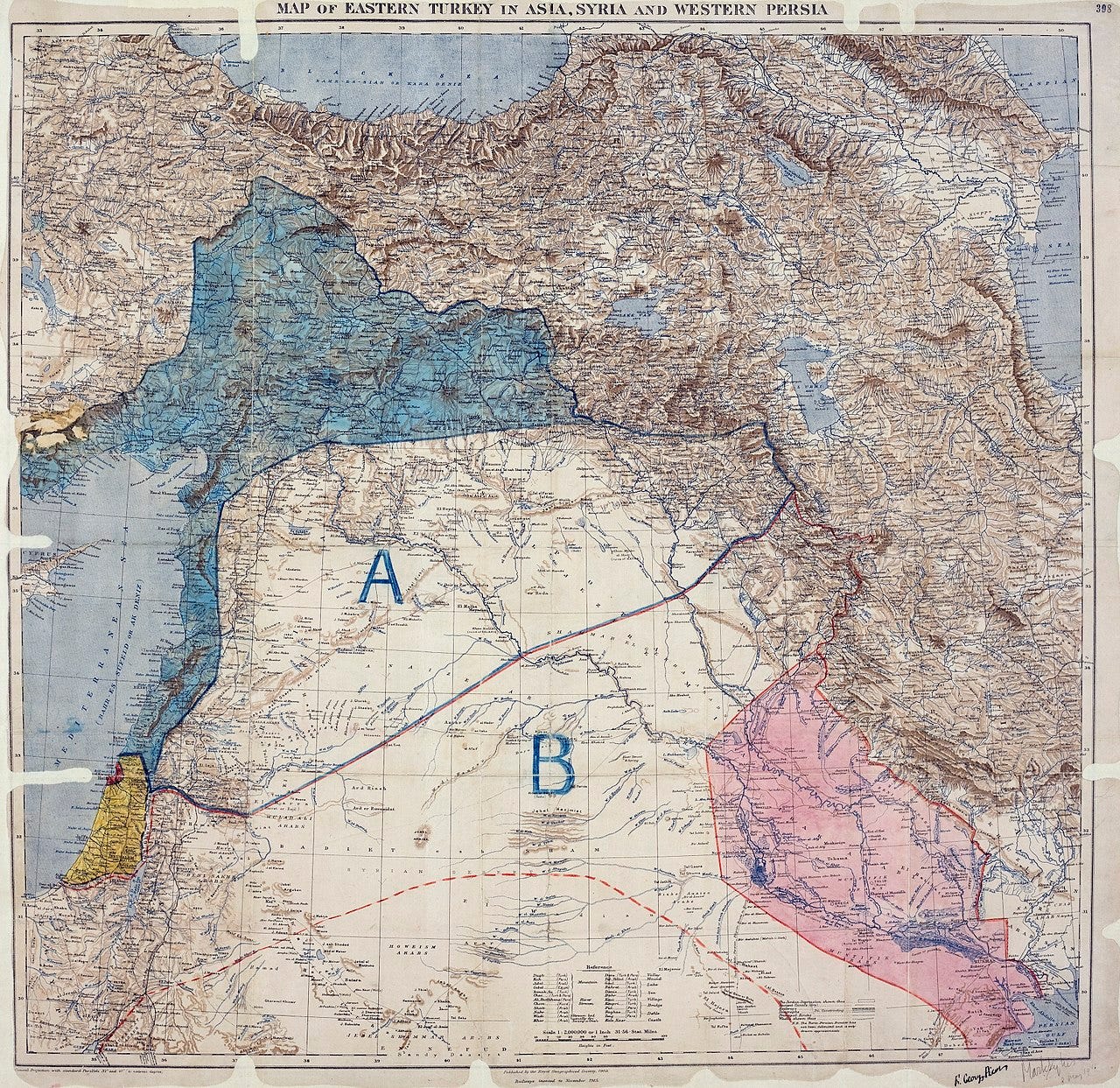
It is not hard to see why this story appeals. It has villains. It has a document. It has a map. It has a date. It has that special explanatory tidiness that history almost never provides, but which public argument is always desperate to find. It also has the great advantage of being partly true.
The Sykes-Picot Agreement really was a secret imperial bargain. In 1916, Britain and France, with Russian assent, discussed how Ottoman Arab territories might be divided into zones of control and influence if the Entente powers won the war. The agreement’s own language is full of the mechanics of imperial privilege: priority of enterprise, local loans, advisers, foreign functionaries, ports, spheres, access, control. It is not a pretty document. It does not need to be rescued from its reputation.
So the problem with the Sykes-Picot myth is not that Mark Sykes, François Picot, or their less-mentioned Russian counterpart Sergei Sazonov were innocent. They were not. The problem is that the agreement has become too useful and too lazy an explanation. It is asked to explain more than it can bear.
That distinction matters. A historical episode can be symbolically powerful while still being explanatorily inadequate. Sykes-Picot is an excellent symbol of imperial arrogance. It captures, in a particularly neat form, the habit of European powers treating foreign lands as pieces on a board; assets to be allocated, routes to be secured, influence to be apportioned. If you want a shorthand for the moral atmosphere of wartime imperial diplomacy, Sykes-Picot will do nicely.
But shorthand is not explanation. And the more we treat Sykes-Picot as the master key to the modern Middle East, the more the actual history disappears.
This mattered in 2014, when Islamic State made the symbolism literal. Its propaganda campaign around the End of Sykes-Picot presented the demolition of the Iraq-Syria frontier as an assault on the old colonial order. Daesh released English- and Arabic-language material showing fighters destroying parts of the border infrastructure and symbolically creating a single territory across Iraq and Syria. The image was irresistible: jihadists with bulldozers erasing the line drawn by European imperialists.
It still matters now. In 2026, with Gaza devastated by prolonged war, Israel expanding territorial control inside the strip, and a wider regional conflict involving Iran disrupting politics and shipping across the Gulf, the temptation to reach for a grand origin story remains powerful. Reuters reported today that Netanyahu had directed Israeli forces to expand control in Gaza to 70% of the territory; separate reporting has described the 2026 Iran war as having widened the conflict across the region, with consequences for Gulf shipping and neighbouring states.
That does not make the colonial age irrelevant. It does mean we should be wary of letting it become a historical vending machine: insert crisis, receive colonial explanation.
The older I get, the less patience I have with explanations that are satisfying in exactly the way they are inadequate. The Sykes-Picot story is one of these. It offers an answer which is not quite wrong, but which becomes wrong through overuse. It gives us a morally legible past, at the cost of flattening the very thing we claim to be trying to understand.
The real history is worse, and more interesting.
The collapse of the Ottoman Empire was not settled by Mark Sykes and François Georges-Picot in 1916. It unfolded through a long, violent and contingent crisis stretching from before the First World War to several years after it. To make sense of the modern Middle East, one has to widen the frame: the Italian invasion of Libya in 1911, the Balkan Wars of 1912–13, Ottoman defeat and radicalisation, the rise of the Young Turks, German-Ottoman strategy, Russian ambitions in the Black Sea, British anxieties over India and the Suez Canal, French claims in Syria and Lebanon, Arab dynastic politics, Zionism, Armenian genocide, Greek expansionism, the Mandate system, the Turkish War of Independence, and the final settlement at Lausanne in 1923.
That is not as elegant as two men and a ruler. History is often inconsiderate like that.
Sean McMeekin is useful here because he forces the argument out of its narrow Anglo-French groove. The Berlin-Baghdad Express follows Germany’s attempt to use its Ottoman alliance, the Berlin-Baghdad railway, and pan-Islamic politics as instruments of world power during the First World War. The Ottoman Endgame widens the story further, framing the making of the modern Middle East through war, revolution and imperial collapse across the first three decades of the 20th century. One need not accept every emphasis in McMeekin’s account to see the corrective value. The Ottoman Empire was not simply a passive body on an operating table while Britain and France sharpened the knives. Germany was not incidental. Russia was not marginal. Ottoman leaders were not decorative, and local power-brokers and strongmen within the empire were not waiting politely for Europeans to pick them.
This is the first thing the Sykes-Picot myth obscures: the post-Ottoman Middle East was not made by one agreement. It was made by a series of interconnected wars spanning decades, born of European imperial ambitions but also of local political, ethnic, cultural and religious divides.
The second thing it obscures is that the war did not end neatly in 1918.
If the modern settlement had simply been imposed by Allied fiat, the Treaty of Sèvres in 1920 would have mattered more than Lausanne. Sèvres was the punitive, maximalist postwar settlement for the Ottoman Empire. It envisaged enormous losses of sovereignty and territory, including Allied zones, Greek expansion, and provisions that Turkish nationalists considered intolerable. But Sèvres was never fully ratified or implemented. It was overtaken by force. The Turkish national movement under Mustafa Kemal fought, won, and compelled the Allies back to the negotiating table.
The Treaty of Lausanne in 1923 then recognised the boundaries of the modern Turkish state. Turkey made no claim to its former Arab provinces; the Allies abandoned several claims they had previously pursued, including autonomy for Turkish Kurdistan and territorial cession to Armenia. Whatever else Lausanne was, it was not Sykes-Picot being rubber-stamped seven years late. It was the result of military defeat, nationalist victory, diplomatic retreat and hard bargaining.
This is where the familiar story begins to wobble. If Sykes-Picot was the blueprint, why did so much of the final settlement emerge through later war and revision? Why did Sèvres fail? Why did Lausanne replace it? Why did Mosul become a subsequent dispute? Why did the borders of Turkey come to be settled by Kemalist success rather than by the wartime dreams of British and French officials? Why did then-Persia remain intact? Why did some projected zones of influence never take the form imagined for them?
The answer is not that Sykes-Picot did not matter. It did. The answer is that it mattered as one episode in a wider imperial scramble, not as the master document from which everything else followed.
This is especially important in Palestine, because Sykes-Picot is sometimes also made to stand in for the whole tangled set of British wartime commitments: promises to Arab leaders, understandings with France, Zionist diplomacy, strategic anxieties, and later Mandate administration.
The significance of this is not that Sykes-Picot is unrelated to Palestine. The agreement placed a rump state in Palestine under an international administration to be agreed with Russia and other allies, which is itself revealing. The point is that Palestine cannot be explained by Sykes-Picot alone. The conflict’s later development involved the Balfour Declaration, British Mandate policy, Zionist immigration and institution-building, Palestinian Arab opposition, imperial retreat, UN partition, war, displacement, state formation, occupation, nationalism, religion, regional rivalry, settlement, American power projection, and repeated failures of diplomacy. To say Sykes-Picot over this history is not to explain it. It is to put a label over it.
The same is true of Iraq and Syria. The border between them - one of the few lines from the original Sykes-Picot map which did basically survive the agreement - became the poster child for the Sykes-Picot myth, but the actual states themselves were formed through mandate rule, local revolt, military occupation, dynastic bargaining, administrative improvisation and later authoritarian consolidation. Their problems cannot be reduced to the artificiality of a single line. The more useful question is not whether a state’s borders are artificial, but whether the institutions inside them gained legitimacy, capacity and durability.
This is where the Sykes-Picot explanation becomes actively misleading. It encourages us to imagine that the Middle East’s central problem is bad cartography. As if the region would have been spared its tragedies had only the lines been more aesthetically sensitive, perhaps with a little more attention to ethnographic shading. This is comforting, in its way. It locates violence in the geometry of the map rather than in the harder history of power: armies, parties, monarchies, oil companies, foreign interventions, patronage networks, sectarian mobilisation, secret police, coups, sanctions, invasions, occupations and civil wars.
Bad borders can matter. Of course they can. Borders can trap minorities, divide communities, reward clients, punish enemies, and convert administrative convenience into permanent grievance. But the great error of the Sykes-Picot story is to confuse map logic with political history.
This is also why the anti-imperial critique loses force when it becomes too neat. British and French (and Russian and German and Italian) imperialism did enormous damage in the region. It treated local agency and sovereignty as something to be managed (at best), ignored, or destroyed (at worst). There is no need to soften that. But blaming Sykes-Picot for everything risks letting imperialism off the hook ,by making it seem like a single decision made by bad actors rather than a system of practices.
The British did not need Sykes-Picot to be duplicitous in Palestine. The French did not need Sykes-Picot to pursue their ambitions in Syria and Lebanon. Russia did not need Sykes-Picot to covet Armenia or Constantinople and the Straits. Germany did not need Sykes-Picot to cultivate pan-Islamic agitation against its enemies. Ottoman leaders definitely did not need Sykes-Picot to centralise, gamble with, repress, deport, or massacre their own citizens. Later dictators did not need Sykes-Picot to build prisons, secret police states, and cults of leadership. The United States did not need Sykes-Picot to invade Iraq. Iran and Saudi Arabia did not need Sykes-Picot to pursue regional competition. Israel did not need Sykes-Picot to occupy Palestinian territory. Hamas did not need Sykes-Picot to massacre civilians. Hezbollah, Assad, the Ba’athists, the Hashemites, the PLO, the Gulf monarchies, the Iraqi army, the CIA, the IDF, the IRGC, and UN diplomats all belong somewhere in this history too.
That is not a pithy slogan. It is not meant to be. The untidiness is the whole point.
One reason the Sykes-Picot myth survives is that it performs a moral simplification. It gives progressive Western audiences a way of admitting imperial guilt without having to understand very much about what they’re admitting to. It says: yes, we made a mess; two of our men drew the wrong line; the consequences followed. There is a kind of shallow contrition in this. It looks like historical seriousness, but in the worst case it’s just another form of self-centring. Even in guilt, Europe still gets to be the centre of attention.
The actual history is less flattering and less convenient. The injustices of European empires mattered profoundly, but they were not omnipotent. Local actors mattered enormously too, though not always nobly. Anti-colonial movements could be both liberatory and authoritarian. National self-determination could coexist with ethnic violence. Imperial retreat could produce freedom in one place and abandonment in another. The Ottoman Empire was not a paradise of pluralism before Europeans descended with their pencils. Nor was it simply a doomed relic awaiting partition. It was a real imperial state, modernising and decaying, coercive and adaptive, capable of reform and catastrophe.
This is why Lausanne matters so much as a corrective. It reminds us that the post-Ottoman order was not merely imposed; it was contested. The Turkish national movement did not accept the settlement prepared for it. It fought, and it changed the result. That does not make the final order just. Lausanne came with its own human costs, including the compulsory population exchange between Greece and Turkey. It does, however, make the history harder to narrate as a simple morality play.
A better account would treat Sykes-Picot as one layer in a palimpsest. Beneath it lie Ottoman structures, provincial identities, imperial rivalries, religious communities, trade routes, dynastic ambitions and local politics. Around it sit the Hussein-McMahon correspondence, the Balfour Declaration, Russian claims, French and British military occupations, and wartime bargaining. Above it come Sèvres, the mandates, Lausanne, state-building, anti-colonial revolts, coups, oil politics, Cold War alignments, American intervention, Islamist movements, authoritarian collapse and the accumulated failures of governing elites.
That is harder to fit on a graphic. It is also much closer to reality.
None of this means Sykes-Picot should be discarded. Symbols matter in politics because people act through symbols. Daesh understood that perfectly well. It chose the Iraq-Syria border not because it had conducted a dispassionate seminar on the finer points of wartime diplomacy, but because Sykes-Picot had become a name for humiliation, division and imposed order. In that sense, the myth became politically real. A bad explanation can still motivate real action.
But historians and commentators owe us more than the reproduction of a myth because the myth is potent. The fact that Sykes-Picot matters symbolically is precisely why it needs to be handled carefully. Otherwise, we end up confusing the history people invoke with the history that happened.
The question, then, is not whether Sykes-Picot was bad. It was.
It is not whether imperialism matters. It does.
It is not whether borders can produce grievances. They can.
The question is whether one secret agreement in 1916 can bear the explanatory weight placed upon it. It cannot.
Sykes and Picot belong in the story, but not in the starring roles to which posterity has oddly promoted them. They were participants in a wider process: one crowded with soldiers, ministers, revolutionaries, dynasts, nationalists, colonial officials, railway men, generals, propagandists, oil interests, religious leaders and insurgents. The story’s dramatis personae come from pretty much every major European state involved in the First World War, but also draws its key figures from North Africa, the Middle East, and as far afield as Afghanistan. It was written in chancelleries, certainly; but also on battlefields, in collapsing provinces, in refugee columns, in cabinet rooms, in nationalist assemblies, in imperial offices and in the ruins of failed settlements.
A famous name is not the same thing as an adequate explanation.
That, finally, is the trouble with Sykes-Picot. Not that it tells us nothing, but that it lets us stop too soon. It allows us to mistake recognition for understanding. It gives us the satisfying click of a pattern falling into place, when what we need is the patience to see how many patterns were layered over one another.
The Middle East was not broken by a line. It was remade through the collapse of empires, the violence of war, the improvisations of victors, the resistance of the defeated, the ambitions of local rulers, the failures of new states, and the repeated interference of outside powers who were almost always less clever than they imagined and more destructive than they admitted.
Sykes-Picot is part of that history. It is not the history.
And if we want honest answers about the modern Middle East, we need to stop mistaking a useful symbol for the truth.
Annotated bibliography
The Sykes-Picot Agreement, 1916, Avalon Project.
Used for the primary text of the agreement itself, particularly its language around British and French zones of control and influence, local loans, advisers, and proposed arrangements for Palestine. (https://avalon.law.yale.edu/20th_century/sykes.asp)
Meghan Tinsley, ‘Whose colonialism? The contested memory of the Sykes-Picot Agreement’.
Used for the discussion of Daesh/Islamic State propaganda in 2014, especially the End of Sykes-Picot campaign and the symbolic destruction of the Iraq-Syria border. (https://pomeps.org/whose-colonialism-the-contested-memory-of-the-sykes-picot-agreement)
Reuters, ‘Netanyahu directs Israeli forces to expand Gaza control to 70 percent’.
Used to frame the 2026 relevance of the article: the Middle East remains in violent flux, and current crises again tempt commentators towards sweeping historical explanations. (https://www.reuters.com/world/middle-east/netanyahu-directs-israeli-forces-expand-gaza-control-70-percent-2026-05-28/)
Reuters, ‘How has the Iran war affected Middle East states?’
Used for the current 2026 regional context, including the wider effects of the Iran war on neighbouring states, Gulf shipping and regional politics. (https://www.reuters.com/world/middle-east/how-has-iran-war-affected-middle-east-states-2026-05-13/)
Sean McMeekin, The Berlin-Baghdad Express.
Used as a major interpretive source for widening the story beyond Britain and France, especially Germany’s Ottoman strategy, railway geopolitics and wartime use of pan-Islamic politics. (https://www.hup.harvard.edu/books/9780674064324)
Sean McMeekin, The Ottoman Endgame.
Used for the broader frame of Ottoman collapse between 1908 and 1923, helping to move the essay from a narrow 1916 focus to the longer sequence of revolution, war, partition, resistance and settlement. (https://www.penguin.co.uk/books/187942/the-ottoman-endgame-by-mcmeekin-sean/9780718199715)
Balfour Declaration, 1917, Avalon Project.
Used to distinguish Sykes-Picot from Britain’s later and separate commitment to support a Jewish national home in Palestine, while supposedly protecting the civil and religious rights of existing non-Jewish communities. (https://avalon.law.yale.edu/20th_century/balfour.asp)
Treaty of Sèvres summary.
Used for the discussion of the failed 1920 postwar settlement, which Turkish nationalists rejected and which was superseded after the Turkish War of Independence. (https://en.wikipedia.org/wiki/Treaty_of_S%C3%A8vres)
Britannica, ‘Treaty of Lausanne’.
Used for the 1923 settlement: recognition of the modern Turkish state’s boundaries, Turkey’s abandonment of claims to its former Arab provinces, and the Allies’ retreat from several earlier demands. (https://www.britannica.com/event/Treaty-of-Lausanne-1923)
Qatar Digital Library, ‘Lausanne’s Legacy’.
Used for the point that Lausanne delimited boundaries and was tied to the compulsory population exchange between Greece and Turkey, helping avoid an over-neat or celebratory account of the Turkish nationalist victory. (https://www.qdl.qa/en/lausanne%E2%80%99s-legacy-peace-treaty-led-century-conflict)