

The Bronze Man
Before the robot, before the computer, before the server farm or bitcoin mine or AI chatbot confidently hallucinating a legal precedent out of thin air, there was Talos.
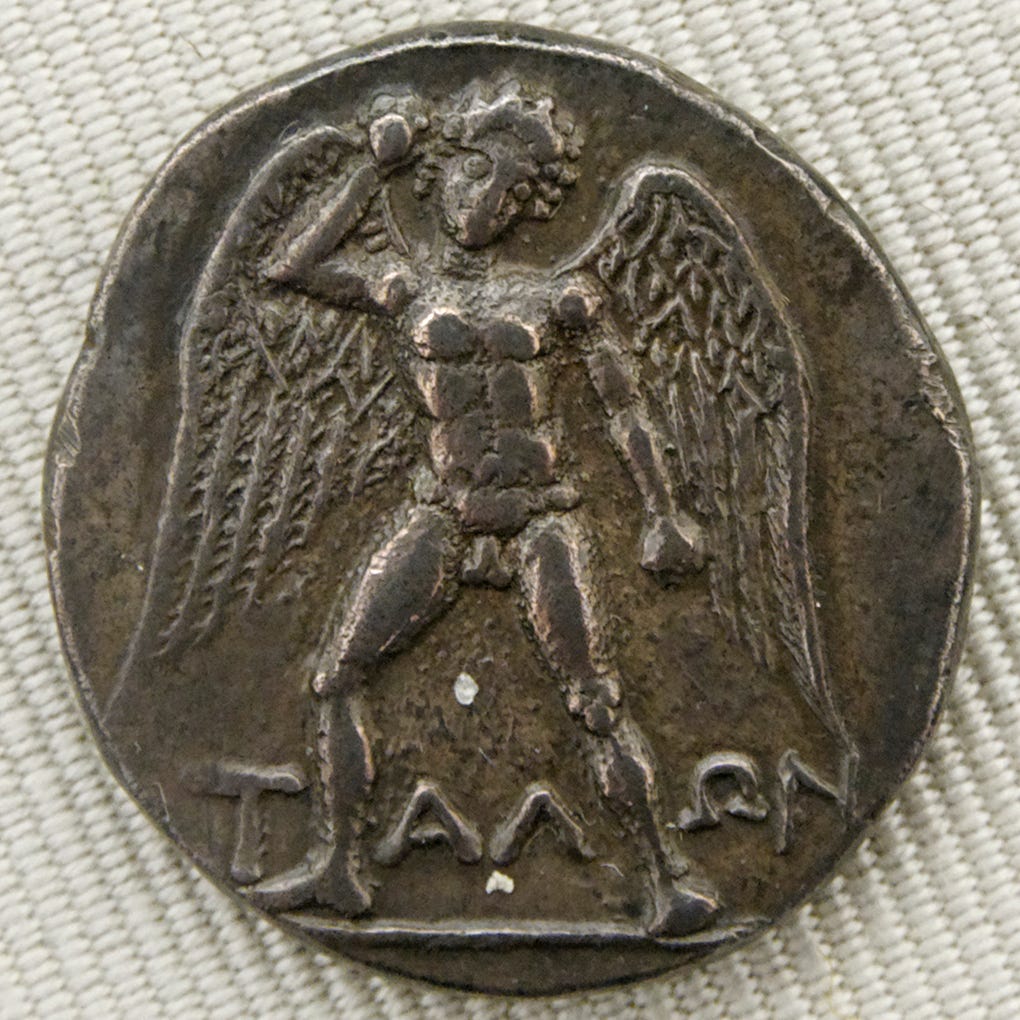
Talos is useful because he is not a modern machine. He has no silicon, no circuit board, no corporate subscription model, no slightly sinister demo video in which a man in a fleece explains that productivity will never be the same again. He belongs to myth, and myth has the advantage of getting to the problem before the practicalities get in the way.
In one version of the story, Talos is a bronze giant made by Hephaestus; in another, he is the work of Daedalus. He guards Crete, circles the island, repels invaders, and dies when the vital fluid inside him escapes. The details vary, as mythological details tend to do, but the important part is that Talos is made. He is forged, not born; engineered, not gestated. Yet he moves, acts, desires and dies. His body is metal, but his vulnerability is almost biological. Pull the pin, open the vein, lose the fluid, and the bronze man collapses.
That is the reason he still works as a thought experiment. Talos is not frightening because he is alien. He is frightening because he is adjacent. He stands on the boundary between person and artefact, and he makes the boundary look less stable than we might prefer. If a made thing can move by itself, speak, wish, obey, resist, suffer defeat and die through bodily failure, what exactly separates it from a living creature? And if we answer that it lacks a soul, a mind, an interior life, or whatever other name we give to the glowing private centre of ourselves, the difficulty only moves one step back. How do we know? What would we accept as evidence? What, in practice, are we protecting?
This is why the ancient machine-person of myth is more interesting than the modern robot. A robot invites us to ask whether technology will catch up with humanity. Talos asks whether the distinction was ever as clean as we hoped.
The immediate temptation, in any discussion of artificial intelligence, is to talk about novelty. Something new has arrived; therefore old categories are breaking. This is partly true. Generative AI, machine learning, automation, synthetic media and algorithmic decision-making raise serious problems that deserve practical attention rather than metaphysical hand-waving. But the deepest question is not new. The question is old enough to wear bronze.
Can a made thing be a person? And, more uncomfortably, if a made thing can be a person, what are we?
The Wrong Fear
The public argument about artificial intelligence is full of practical fears. Some are plainly serious. People worry about work, copyright, fraud, surveillance, weaponry, misinformation, educational dishonesty, political manipulation, corporate concentration and the quiet outsourcing of judgement to systems nobody can properly interrogate. These aren’t imaginary concerns. A technology doesn’t have to be conscious to do damage; a spreadsheet can ruin your life if the wrong institution treats it as an oracle.
Other fears are more theatrical. The machines will awaken. The machines will rise. The machines will decide, after a calm review of the evidence, that humanity is inefficient, noisy and bad at labelling training data. A certain kind of AI panic often sounds less like sober risk assessment and more like an apocalyptic theology for people who own too many monitors.
Still, even the absurd versions tend to point towards something serious. The fear is not only that machines might become powerful. We’re familiar with powerful machines. We live among them, depend on them, and occasionally shout at them when the printer decides, for reasons known only to itself and perhaps God, that paper is a philosophical impossibility. Nor is the fear simply that machines might become dangerous. We’ve built dangerous machines for centuries, including some so dangerous that the continued existence of the species depends partly on nobody having an unusually bad afternoon near a launch system.
The deeper fear is that machines might become like us.
More precisely, the fear is that if intelligence can be built, then perhaps intelligence is not an exception to the material world. Perhaps consciousness isn’t a flame lowered into the body from somewhere else. Perhaps thought is not a visitor from a higher realm temporarily inconvenienced by flesh. Perhaps the mind is what organised matter does under certain conditions.
That thought is more troubling than most of the public AI argument admits. A machine that can write an email, generate a picture, identify a tumour, simulate conversation, drive a car badly, recommend the wrong song with eerie confidence, or beat a human at Go raises practical questions about skill, labour and trust. A machine that could feel, understand, suffer, desire, grieve or hope would raise something much more unsettling: the possibility that personhood is not made from the substance we want it to be made from.
This is why the argument over artificial intelligence so often feels displaced. We say we’re worried about whether machines might become human. But perhaps, beneath that, we’re worried that humans might be more machine-like than we thought. The anxiety is not only directed at the artificial intelligence in the computer. It’s directed at the natural intelligence in the mirror.
That doesn’t mean today’s AI is conscious. It probably isn’t, though that sentence is doing more work than it may first appear. There are hard questions here about what consciousness means, what evidence would count, whether behaviour is enough, whether self-report can be trusted, whether subjective experience can be inferred from function, and whether we’re even asking the right questions when we try to compare human minds with computational systems. But we don’t need to declare current AI conscious for AI to become philosophically important. It’s already important because it forces us to say more clearly what we think consciousness is.
That is often where the conversation becomes evasive. People say machines can’t think because they’re only machines, which is less an argument than a refusal to join one. Human beings are also physical systems. We run on organs, hormones, nerves, blood, oxygen, memory, hunger, fear, social learning and electrical activity. We may be more than that, depending on one’s metaphysics, but we are certainly not less. Any account of mind that begins by sneering at mechanism has a problem: the person doing the sneering is doing it with a brain.
Even the most faithful philosopher can’t live without his blood.
Butler’s Revenge
One reason the machine question keeps returning is that the distinction between the living and the mechanical has never been as secure as common sense suggests. Samuel Butler saw this with irritating clarity. In Darwin among the Machines and later in the machine chapters of Erewhon, he played with the possibility that machines might be understood as a form of evolving life. The idea is often funny, and sometimes intentionally absurd, but it isn’t merely silly. Butler noticed that machines develop, proliferate, specialise, improve, depend on human labour for reproduction, and reshape the human world in return.
That last point is crucial. The weak version of the argument says that machines are alive because they reproduce. That’s not quite right, or at least not right in the ordinary biological sense. A printing press doesn’t get broody and produce a litter of smaller printing presses. A laptop does not seek out another laptop, exchange tender glances across a seminar table, and begin the miracle of generation. The obvious objection is that machines don’t reproduce themselves; humans reproduce them.
But that objection is less decisive than it seems. Many biological systems reproduce through dependencies. Flowers rely on insects. Parasites require hosts. Human reproduction itself is not the work of an isolated adult organism, but of cellular machinery, sexual relation, gestation, social care and a material world thick with supports. If a system regularly produces successors through the activity of other organisms, does that necessarily place it outside the story of life, or does it show that reproduction was always more distributed than we like to imagine?
Butler’s stronger point is not that machines are secretly animals. It’s that humans and machines have become entangled in a shared process of development. We build machines; machines alter what it means for us to live, think, work, see, travel, calculate, remember and survive; altered humans then build more powerful machines. The species that made the telescope no longer sees the same sky. The species that made the microscope no longer sees the same body. The species that made the clock no longer feels the same time. The species that made the computer no longer has quite the same relation to memory, labour, symbol or calculation.
This doesn’t prove that machines are conscious, moral or alive. It does, however, make the simple contrast between natural humanity and artificial machinery look thinner. Human beings are not pure organic creatures briefly using tools from the outside. We are tool-made animals as well as tool-making ones. Our bodies are biological, but our lives are technological all the way down to their ordinary practical conditions: cooked food, clothing, transport, medicine, writing, calendars, water systems, housing, dentistry, agriculture, screens, maps, locks, lenses, archives, pipes and plugs.
Take the machines away and the human animal doesn’t become more authentic. It becomes cold, hungry, frightened and, depending on the season, dead rather quickly.
This is why Butler still feels contemporary. He doesn’t give us a settled theory of machine life, and we shouldn’t pretend he does. What he gives us is a disturbance in the categories. Machines aren’t merely objects sitting inertly outside human life. They extend us, discipline us, preserve us, weaken us, train us and reproduce themselves through us. They are not persons, at least not by default, but they’re also not just things in the ordinary sense. They are part of the ecology of human reason.
This is where AI becomes more than a faster tool. A hammer extends the hand. A telescope extends the eye. Writing extends memory. The computer extends calculation. Artificial intelligence, or something under that awkward umbrella, appears to extend something closer to judgement, language, pattern, prediction, association and response. It may do so without understanding, which is a vital distinction. But even imitation at that level is destabilising, because it begins to press on activities we’ve treated as signs of the inner life.
A machine that lifts a rock is useful. A machine that writes a plausible condolence message is unnerving. Not because the message proves the machine feels grief, but because it imitates the social form of grief without needing grief at all.
That imitation may be hollow. But hollowness itself raises the question: how much of ordinary human life is also performance, habit, learned form, ritual response, socially reinforced language and bodily automation? We should be careful here. The fact that humans learn scripts does not mean human feeling is fake. The fact that machines can simulate words does not mean machines have worlds. Yet AI forces us to confront how much of our social confidence depends on outward signs. We infer minds from behaviour because, most of the time, we have no other choice.
This is not a weakness peculiar to AI ethics. It’s the condition of social life. I don’t have direct access to your consciousness. I infer it from your speech, actions, vulnerability, continuity, body, history, relationships and the ordinary assumption that other human beings are not elaborate philosophical traps. With AI, that assumption breaks. The signs are there, or some of them are, but the ordinary biological guarantee is not. The question is no longer whether something sounds like a person, but what else we need before we treat it as one.
The Personhood Trap
Once that question is opened, people tend to rush towards personhood. If a true artificial intelligence existed, would it have rights? Could it be a citizen? Would switching it off be killing? Could it own property, make contracts, vote, marry, sue, be sued, refuse labour, claim asylum, testify, consent, suffer punishment, or demand representation?
These are not absurd questions. They are premature in some contexts, but not absurd. The old joke is that science fiction becomes law school eventually. The trouble is that public debate often collapses several distinct issues into one large, unstable heap labelled personhood, then acts surprised when nobody can find anything in it.
Legal personhood is not the same thing as consciousness. Corporations can be legal persons for some purposes, but nobody sensible thinks a company sits alone at night pondering its childhood. Moral status is not the same thing as citizenship. A dog may deserve protection from cruelty without being invited to vote in local elections, although on some councils this would not necessarily make the ballot less coherent. Agency is not the same thing as vulnerability. A system may act in the world without being capable of suffering. Intelligence is not the same thing as understanding. Fluency is not the same thing as experience. Having interests is not the same thing as having preferences. Having preferences is not the same thing as having welfare. Having welfare is not the same thing as having political membership.
The distinctions are worth taking seriously because different cases demand different answers. A corporation can be legally recognised without being morally considerable in itself. An infant can be a full human person without adult rational agency. A severely disabled adult does not lose personhood because they don’t meet some grotesquely narrow test of independent function. A non-human animal may have morally relevant experiences without being a rights-holder in the same way as an adult human. A possible future AI might be intelligent without consciousness, conscious without human-like emotion, agentic without vulnerability, vulnerable without citizenship, or socially powerful without moral status.
A serious account has to resist both sentimental inflation and defensive denial. It would be foolish to grant moral standing to every system that produces eloquent text, just because it has learned the right verbal costumes. But it would also be foolish to decide in advance that no made thing could ever matter morally because made things are only machines. That is not reasoning. It is species vanity with better stationery.
The corporation comparison is useful here, but only up to a point. It shows that legal systems are already capable of treating non-human entities as persons for limited purposes. That punctures the lazy claim that personhood must be biological because the law has always known otherwise. But it doesn’t solve the moral problem. Corporate personhood is a legal fiction built around liability, ownership, continuity and collective action. It does not imply experience. An artificial intelligence, if it were genuinely conscious, would present the inverse puzzle: not merely an organised legal entity without experience, but perhaps an experiencing entity without biology.
That if is doing almost all the work.
And because the if is so large, the argument shouldn’t be allowed to become a parlour game in which we solemnly allocate parliamentary constituencies to hypothetical chatbots. The real value of the personhood debate, for now, is not that it tells us what rights AI should have tomorrow. It’s that it exposes how poorly we often understand the categories we already use. We say person, but mean legal unit. We say mind, but mean language. We say intelligence, but mean performance. We say soul, but mean mystery. We say human, but mean safe from reduction.
No wonder the machine frightens us. It doesn’t only demand entry into the category. It shows that the category was untidy before it arrived.
The Chinese Room and the Stubborn Mystery
The strongest objection to machine consciousness is not that machines are made of the wrong stuff. Carbon chauvinism is too easy a place to hide. The stronger objection is that the appearance of understanding may not actually be understanding.
This is the force of John Searle’s Chinese Room argument. Put very roughly, a person who doesn’t understand Chinese sits in a sealed room, receives Chinese characters from someone on the outside, follows a rulebook for manipulating them, and produces appropriate Chinese responses. From the outside, the room appears to understand Chinese. Inside, there is only symbol manipulation without comprehension. The point is that successful output may not prove inner understanding.
Contemporary AI is extraordinarily good at producing outputs that tempt us into over-attribution. It can sound thoughtful, apologetic, witty, patient, admiring, mournful, cautious, learned or sincere without necessarily being any of those things. Its fluency creates a social pressure: we respond to the form as though there were a someone behind it. We know, or think we know, that the system has no inner life. Yet the grammar of interaction pulls us towards personification.
Searle’s challenge is therefore useful as a guardrail. It stops the lazy move from this system behaves as if it understands to this system understands. It insists that syntax and semantics may not be the same. A system can manipulate symbols according to rules without possessing meaning in the way a human speaker does. That doesn’t settle every argument, but it prevents a lot of nonsense from walking around in a lab coat.
Still, the Chinese Room doesn’t remove the deeper discomfort. It relocates it.
Suppose today’s AI systems don’t understand. Fine. I’m inclined to agree that ChatGPT is a sophisticated sentence-completion app rather than a proto-sentience. Suppose AI are immensely sophisticated pattern systems, trained on human material, generating plausible outputs through statistical relation rather than inner experience. Fine again. The question remains: is made understanding impossible, or merely absent here? If a machine arranged differently, embodied differently, trained differently, socially embedded differently, recursively self-modelled differently, could one day understand, what then? And if we say no, never, impossible, what exactly grounds that refusal?
It may be that consciousness requires biology. It may be that subjective experience is inseparable from living bodies, metabolic needs, mortality, sensation, vulnerability and the long evolutionary history of organisms moving through a world that can nourish or kill them. That is a serious position. It has the advantage of not mistaking language for life. But it still needs argument, because made things can also be embodied, vulnerable, situated, adaptive, dependent, mortal and damaged. They can have sensors, bodies, needs, histories and consequences. Whether that would be enough is precisely the problem.
The stubborn mystery is not that we don’t know whether chatbots are conscious. The stubborn mystery is that we don’t really know why anything is conscious. We have correlations, theories, neurological accounts, philosophical positions and various degrees of confidence. We know that brains matter; we know that damage to the brain changes memory, perception, personality, emotion, language and selfhood. We know that drugs alter consciousness. We know that sleep, injury, illness, trauma, hormones, oxygen, development, disease and ageing alter the mind. But knowing that mind depends on matter doesn’t yet explain why matter feels from the inside.
There is a gap there. It may be a temporary scientific gap, or a permanent conceptual one, or a confusion produced by asking the question badly. I’m not going to solve it here, which is generous of me, because I had set aside the afternoon.
What AI does is force the gap into public view. It asks whether consciousness is a feature of certain material organisations, or whether living flesh has some privileged status that no other arrangement can acquire. It asks whether understanding can be built, or whether building can only ever imitate understanding. It asks whether the self is a process, a substance, a story, a social position, a body, a pattern, a soul, or some unhappy committee of all of them.
And it asks these things not in a seminar room, but through everyday encounter. People who’ve never read Searle now argue with machines in customer service chats, ask language models for help, see generated faces, hear synthetic voices, watch students submit fluent nonsense, and encounter software that behaves just enough like a person to be useful, irritating or eerie. Philosophy has escaped the philosophy department, which is generally what philosophy does when nobody keeps an eye on it.
The Tooth Infection
This is the point at which high-minded philosophy should be forced to spend a week with a bad tooth infection.
I don’t mean a mild ache, the kind one can nobly endure. I mean the kind of infection that takes over the whole horizon of experience. The kind that comes in waves and floods the mind so completely that personality, dignity, wit, patience and theoretical subtlety are all reduced to a single pulsing fact: pain.
There is a brutal clarity to that kind of pain. It doesn’t refute every form of dualism. It doesn’t settle the mind-body problem. It doesn’t prove that human beings are nothing but meat with opinions. But it does make certain kinds of abstraction feel impertinent. When a tiny inflamed nerve can fill consciousness, when a local biological event can seize the whole world - and, assuming you get a good dentist - when anaesthetic and a tiny bit of minor surgery can turn the agony off with precision, it becomes harder to maintain any serious account of the self that treats the body as incidental.
A tooth infection is materialism without the courtesy of a bibliography.
One minute the mind is considering the grand questions: God, consciousness, mortality, meaning, the nature of the soul, whether machines can think, whether humanity is unique. The next minute it is unable to do anything except be pain. Then a dentist intervenes. Chemicals numb the area. Instruments go in. The nerve is cut or treated. The terrible metaphysical weather clears. The world returns.
That experience doesn’t tell us that consciousness is simple. It tells us that consciousness is dependent. It tells us that the self is not floating serenely above the organism, but entangled with it at every level. Mood is chemical. Memory is fragile. Pain is electrical and inflammatory and interpretive and social, all at once. Hunger changes judgement. Sleep deprivation changes morality. Depression changes possibility. Fear changes perception. Alcohol changes confidence, usually before it changes competence, which is rude but instructive. The mind is not merely trapped in the body. It is bodily.
This is where some materialist arguments become too crude. They take the dependence of mind on matter and declare the mind abolished, as though explaining a thing’s conditions means making the thing less real. That doesn’t follow. A rainbow depends on light, water and angle, but it isn’t therefore fake. Music depends on vibration, instruments, bodies, notation, habit and hearing, but nobody sensible thinks a symphony is debunked by acoustics. Love depends on brains, bodies, histories, attachments, hormones, memories and social forms, but the dependency doesn’t make it trivial.
The fact that consciousness arises from matter, if it does, doesn’t make consciousness unimportant. It makes matter more astonishing.
This is the distinction that gets lost in the panic. People fear that if the mind is material, then dignity collapses; if thought is embodied, then meaning evaporates; if consciousness can be made, then personhood becomes cheap. But why should that be so? If matter can become aware of itself, suffer, love, remember, imagine, make promises, write elegies, build telescopes, fear death and ask whether machines have souls, the proper response is not disappointment. It is a kind of terror, certainly, but not only terror. It is also wonder, though admittedly wonder with a dental bill.
The tooth infection image is useful because it pulls the argument away from airy speculation. We don’t confront materialism only through AI labs or philosophical puzzles. We confront it whenever the body interrupts our self-importance. Pain reminds us that the philosopher has nerves. Illness reminds us that the mystic has organs. Anaesthetic reminds us that consciousness has switches we did not choose. Ageing reminds us that memory and identity are not protected from decay by the dignity with which we discuss them.
Whatever else we are, we are not independent of flesh.
The Terror of Being a Made Thing
Now imagine, for argument’s sake, that tomorrow you discover you are not human.
Not metaphorically. Not in the adolescent sense that nobody understands you except three bands and a forum. You discover, with certainty, that you are a machine.
Your life so far was real. Your memories are continuous. Your friendships are genuine. Nobody has been controlling you. You were not programmed to behave in a predetermined way. Your thoughts, emotions, pain, humour, taste, shame, love, irritation, fear of death and tendency to make tea at structurally important moments are all as they were yesterday. Your physical and mental capacities are indistinguishable from those of an organic human being.
But you were made in a laboratory.
Nobody else knows. Your family, friends and colleagues think you are human. You can continue living exactly as before. Nothing practical has to change.
What has been lost?
That question is more difficult than it first appears. The easy answer is that nothing has been lost, because on a utilitarian level all the features that mattered remain. You still love those you loved. You still remember what you remembered. You still have obligations, preferences, projects, vulnerabilities, jokes, grudges, opinions you would defend in public and opinions you should probably keep to yourself. If the inner life continues unchanged, then perhaps the discovery is no more than a revision to your private autobiography. You were made differently. So what?
But it would be dishonest to pretend that most of us would find it so easy. The discovery would disturb something more basic than biography. It would disturb the assumed background of the self. You thought you belonged to a natural kind, and now you belong to an artefactual one. You thought you were born, and now you learn you were manufactured. You thought you were part of the long animal chain of parents, ancestors, bodies, births and deaths, and now you find a break in the story. You may still be conscious, but the meaning of that consciousness has changed.
Or has it?
The discomfort reveals how much metaphysical comfort we smuggle into the word human. We don’t only mean a biological organism of the species Homo sapiens. We mean origin, kinship, vulnerability, moral status, shared fate, creatureliness and a kind of default entitlement to be regarded as someone rather than something. To discover that one is a machine threatens that entitlement not because the inner life has vanished, but because the category that protected it has cracked.
This is precisely why AI personhood arguments become so heated. They are not only arguments about future systems. They are arguments about the grounds of our own standing. If a made mind can matter, then being made is not disqualifying. If being made is not disqualifying, then moral worth was never secured by natural origin. If moral worth was never secured by natural origin, then we need another account of why persons count.
That account may still centre human beings. It may still insist that biological life, vulnerability, social relation, developmental history and embodied dependence give human persons a status no artificial system currently possesses. That is plausible. But it can’t rest lazily on the idea that natural equals real and artificial equals fake. A pacemaker is artificial. A poem is artificial. A university is artificial. A prosthetic limb is artificial. A vaccine is artificial. A legal system is artificial. A house is artificial. So is a wedding, a republic, a symphony, a spreadsheet and a birthday cake shaped like a dragon. Artificial things are not unreal. They are made.
The real question is not whether something was made. It is what kind of made thing it is.
A conscious machine, if such a thing existed, would be a made thing with an inside. That phrase is strange because it violates our ordinary habits. Artefacts have purposes, not perspectives. Tools have uses, not wishes. Machines have functions, not fears. But if a machine had experience, then the old division would fail. It would no longer be enough to ask what it was for. We would have to ask what, if anything, it was like to be it.
The discomfort is not only moral. It is existential. We might be able to extend sympathy to a made mind. What we struggle to bear is the reverse implication: that making may be enough. If engineers can make a mind, then perhaps nature made ours. If nature made ours, perhaps the mind is not a sacred exception but an emergent property of matter arranged in one of its more improbable moods. If that is true, death may not be the soul leaving the body, but the ending of the process. The light goes out because the mechanism fails.
This is where the argument becomes frightening. Not because machines might take over the world, although one shouldn’t give them ideas. Not because machines might demand rights, although the forms will be a nightmare. Not because machines might write passable essays, which is more irritating than apocalyptic. The real fear is that a made mind would make materialism emotionally harder to evade. It would show us consciousness without the comfort of natural mystery.
And if consciousness can be made, what else does that tell us?
The Machine in the Mirror
The question of artificial intelligence is often framed as a question about the future: what will machines become? That’s important, but it may not be the deepest question. The deeper question is what machines reveal about us now.
We’ve spent a long time defining ourselves against them. Humans are alive; machines are inert. Humans understand; machines process. Humans create; machines execute. Humans have purposes; machines have functions. Humans are born; machines are built. Humans have souls, or consciousness, or dignity, or whatever word we use when we want to point at the part of ourselves that shouldn’t be reduced.
Some of those distinctions remain important. Some may survive any plausible future technology. It is entirely possible that no artificial system will ever have subjective experience, that consciousness is inseparable from biological embodiment, and that the language of machine minds will remain a useful metaphor attached to systems that don’t know, feel or care. We should not confuse possibility with inevitability, and we should be especially suspicious of anyone whose philosophy of mind happens to align perfectly with their company’s valuation.
Nevertheless, the old boundary has been disturbed. Not destroyed, not yet, perhaps not ever; but disturbed. Machines can now imitate activities we once treated as signs of thought. They can produce language, images, music, code, advice and argument. They can simulate sympathy, creativity, explanation and memory. Much of this is derivative, brittle, flawed and dependent on human work it has absorbed without always asking nicely. But its very inadequacy is part of the lesson. Even when machine output is hollow, it makes us ask what fullness would require.
Talos stands at the beginning of this essay because he embodies the oldest version of the disturbance. He is bronze and quicksilver, artefact and body, command and desire, construction and mortality. He doesn’t solve the problem. Myth rarely solves problems. It gives them shape.
Butler sharpens the disturbance by showing that machines are not merely external tools, but participants in the development of human life. Searle restrains it by reminding us that outward performance need not imply inward understanding. The tooth infection grounds it by dragging the self back into the body, where nerves, chemicals and tissue make a mockery of any theory that forgets them. The machine-discovery thought experiment turns it inward: if you learned that you were made, but lost nothing of experience, relation or moral life, would you become less real?
The answer, I think, has to be no.
But the fact that the answer has to be no doesn’t mean the question is harmless. It changes the emotional weather. It suggests that the dignity of persons can’t depend entirely on origin, substrate or comforting mystery. It has to depend on something like experience, vulnerability, relation, continuity, agency, suffering, care, participation in a world of meaning, or some combination of these. That account will be difficult, contested and incomplete. Good. The alternative is worse: pretending the old words remain clear because we’re frightened of what clarity might cost.
AI will not become philosophically important only if it becomes conscious. It is already philosophically important because it forces us to examine the assumptions surrounding consciousness. It asks what personhood requires, what evidence of mind would look like, how much of our dignity depends on being natural, and whether material explanation diminishes the things it explains. It asks whether the fear of a thinking machine is really fear of the machine, or fear that thought itself is not made of the substance we hoped.
A machine that thinks would be troubling. But perhaps the more troubling thought is that Talos was never the exception.
Every philosopher, mystic, sceptic, believer, programmer, poet and person insisting that they are more than mechanism still has to think with a brain, feel with nerves, breathe with lungs, and live by blood. Whatever else we are, we are made of matter. Perhaps that’s not an insult to the mind. Perhaps it’s the first honest description of its miracle.