

The Memory Everyone Wants a Share Of
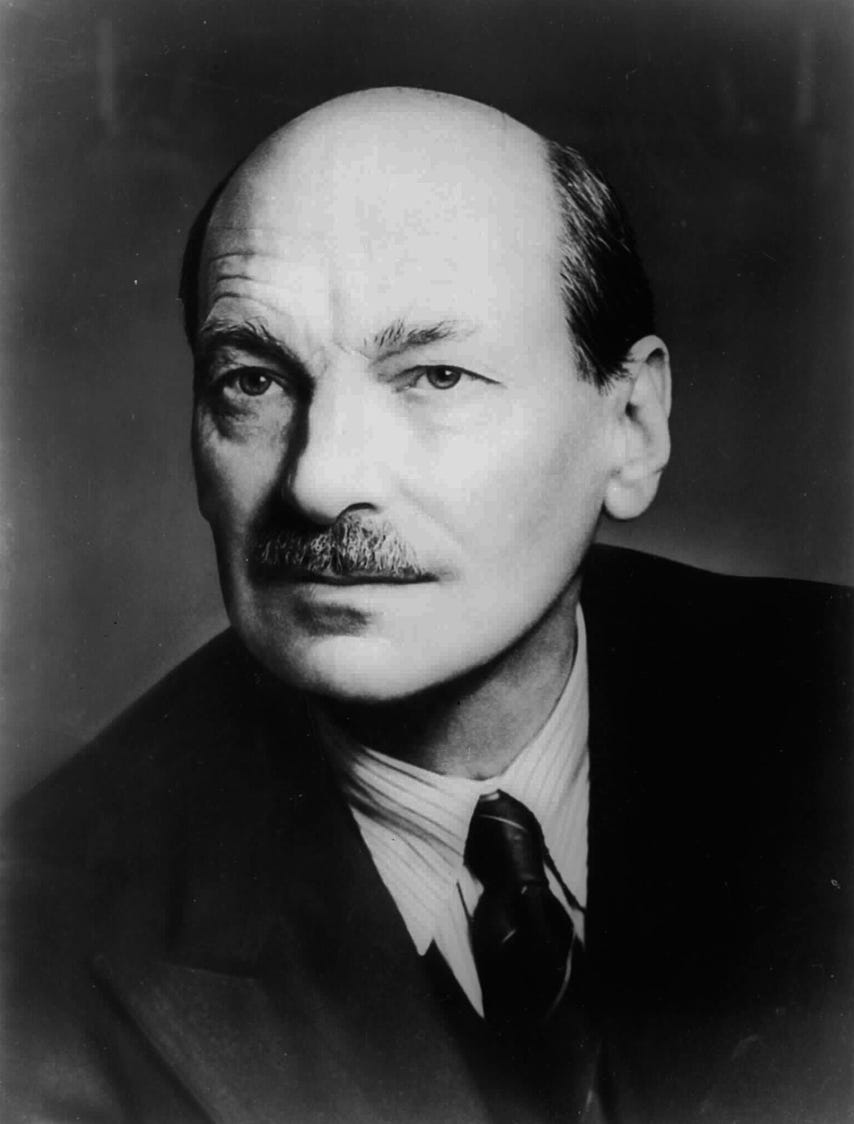
There are some historical governments that belong to a party, and some that escape it. Clement Attlee’s government belongs, in the formal sense, to Labour. It was a Labour government, elected on a Labour manifesto, sustained by a Labour majority, and remembered for institutions that still sit at the emotional centre of Labour’s idea of itself: the NHS, social security, council housing, public ownership, full employment, the welfare state.
And yet Attlee no longer quite belongs to Labour, or at least not only to Labour. He has become one of those figures everyone wants to inherit, usually with the inconvenient parts carefully sanded down first. The socialist left sees in him proof that an unapologetically transformative Labour programme can win a majority. The soft left sees a government that fused moral seriousness with practical reform. The Labour right sees moderation, patriotism, Cabinet discipline, NATO, nuclear weapons, and a Prime Minister who kept the party’s more excitable tendencies on a short leash. One-nation conservatives admire his seriousness (and quietly co-opted his grandson, the 3rd Earl Attlee, who was until recently a Tory peer in the Lords) while hoping nobody notices quite how much of the economy his government took into public ownership.
This is a clue. When everyone claims the same past, they are usually not claiming the whole thing.
The problem is not that the post-war settlement is remembered too fondly. It deserves much of its fondness. The Attlee government was one of the most consequential democratic governments in modern British history. It built institutions that changed the material conditions of life for millions of people. It helped turn insecurity, sickness, unemployment and bad housing from private misfortunes into public responsibilities. It did so through Parliament, not insurrection; through legislation, budgets, administration, compromise and the dreary machinery by which, if we are lucky, civilisation occasionally improves itself.
But the memory has become too neat. The real post-war settlement was not a soft-focus photograph of a grateful nation deciding, as one, to build socialism over tea. It was radical, but not romantic. It was idealistic, but not sentimental. It was collectivist, but also austere, bureaucratic, patriotic, centralising, imperial, military, technocratic, moralistic and, at times, frankly rather bossy. The New Jerusalem was not built in a burst of warm national feeling. It was built with ration books, shortages, wage restraint, bomb damage, Treasury anxiety, professional resistance, American loans, cold houses, tired ministers and queues, queues, queues.
That does not make the achievement smaller. It makes it stranger, harder and more impressive.
The Myth of the Clean Mandate
The 1945 election result is the easiest part of the story to mythologise, because it really was extraordinary. Labour won 393 seats to the Conservatives’ 213, securing its first majority government and ending Winston Churchill’s wartime premiership with a brutality that still seems faintly indecent if the story is told only as a morality play about gratitude.
That is a mandate by any sensible definition. But it was not quite the clean mandate later memory often requires it to be. Britain did not simply wake up in July 1945 as a socialist country. It had been changed by war, by class memory, by the failures of the 1930s, by the experience of evacuation, conscription, rationing, bombing, mobilisation, and by the practical discovery that the state, when forced to do so, could organise the country on a scale previously dismissed as impossible.
Let’s not overstate things. The war did not make everyone socialist, but it did alter the boundaries of the politically plausible for all parties. A state that had directed labour, managed supply, planned production, rationed food and mobilised whole populations could hardly return, without argument, to the comforting fiction that social misery was merely an aggregation of private failures. The Beveridge Report did not arrive from nowhere. It spoke to a country already living inside a vast, improvised experiment in collective provision and national discipline. If it could win the war, could the mechanisms of government also win the peace?
Nor was the vote simply an embrace of public ownership in the abstract. It was a verdict on unemployment, poverty, interwar failure, Tory association with the hungry thirties, and the fear that victory in war might be followed by betrayal in peace. The promise of Labour in 1945 was not merely that it would nationalise industries, but that it would not allow the country to return to the conditions that had made the war’s sacrifices feel, in retrospect, like a pause rather than a transformation.
This is where modern factional memory starts to go wrong. The left is right that Labour won with a programme of enormous ambition. The moderates are right that this ambition was made credible by patriotism, discipline and administrative seriousness. Both are wrong when they turn one half of that truth into the whole thing.
Attlee did not win because Britain had suddenly acquired a taste for abstract ideological maximalism. Nor did he win because he was a cautious manager who kept the Labour party’s more radical impulses in check. He won because Labour had earned the right, through the war and before it, to be trusted with reconstruction, just at a point where the lived experience of being a British citizen made their vision of reconstruction seem both credible and plausible.
The Settlement Was Radical, But Not Romantic
There is a dulling effect that comes with reverence. Institutions become so familiar that their original strangeness disappears. The NHS now sits in British political culture as a kind of civic religion, invoked by people who would not dream of defending the wider assumptions that made it possible. Council housing is remembered either as lost social solidarity or as failed municipalism, depending on one’s chosen polemic. Nationalisation is flattened into a word people either cheer or boo, as though coal, rail, steel, electricity and long-distance haulage were all the same kind of object requiring the same kind of argument.
The Attlee government deserves better than this. Its radicalism was not mainly a mood. It was an institutional programme: The National Health Service Act 1946; the National Insurance Act 1946; nationalisation of coal, electricity, transport, railways and long-distance haulage; the Town and Country Planning Act 1947; the Children Act 1948; and the National Parks and Access to the Countryside Act 1949.
This was not tinkering. It was a deliberate remaking of the relationship between citizen and state. Attlee’s government nationalised roughly one fifth of the British economy. Health care would be provided according to need rather than ability to pay. Working-age people would contribute to a system of social insurance that would support them when they could no longer work. Major utilities and industries would be brought under public control. Land development would become a matter of public permission, not merely private ownership. Children deprived of care would become a public responsibility. Access to countryside would be protected and widened.
It is worth dwelling on this because one kind of revisionism tries to turn Attlee into a moderate whose main virtue was that he kept the left quiet. He did do that, often with some relish - look at how the likes of Harold Laski were kept in their box. But if this is moderation, it is a peculiar form of moderation that creates the National Health Service, rewires social security, nationalises major industries and changes the legal basis of land development.
The better word is not moderate. It is serious.
Seriousness is not the opposite of radicalism. Often it is the condition that makes radicalism matter. The Attlee government was radical because it built things capable of outlasting the rhetoric used to justify them. Its achievements were not merely declarative. They involved structures, budgets, staffing, professional negotiation, local authorities, administrative systems, eligibility rules and all the other unromantic components of real power.
This is why the NHS is such a useful corrective to the myth. It was a moral project, certainly. It was also a political battle with doctors, the British Medical Association, Cabinet colleagues, financial constraints and public expectation. The National Archives notes that while there was broad agreement on the goal of universal healthcare, there were serious disagreements over method; the BMA opposed key elements, and as late as January 1948 described the proposed service as fundamentally unacceptable.
Bevan won, but not by floating above politics. He won through pressure, persuasion, publicity, compromise institutional design, and famously stuffing the mouths of consultants with gold. The NHS launched on 5 July 1948, and 95 per cent of the population had registered before it began. Demand surged. Doctor prescriptions rose from 7 million per month in 1947 to 19 million per month by 1951. The moral breakthrough immediately became an administrative and financial problem, because that is what happens when a right becomes real.
This is not a criticism of the NHS. It is almost the opposite. A utopian promise that never has to survive contact with appointment books, staff shortages and invoices is not yet a public service. The NHS mattered because it translated moral principle into actual use. People got the glasses, the dentures, the consultations and the care they had previously needed but could not afford. That was the point. It was also the cost.
The New Jerusalem Had Queues
If the left sometimes remembers 1945 as an uncomplicated burst of popular socialism, the right sometimes remembers post-war Britain as a grey prison of queues, ration books and dreary collectivist self-denial. The inconvenient truth is that both pictures contain something real. The trick is not to choose one, but to understand why they belonged to the same world.
Post-war Britain was exhausted. It had won the war, but it had not escaped the war’s consequences. Cities had been bombed. Exports had been disrupted. Debt was enormous. The country was short of dollars, short of materials, short of housing, short of food, short of labour in some places and overloaded with expectations almost everywhere. Britain was effectively bankrupt after the war, and the government faced recurring currency crises and shortages of food and resources severe enough that rationing continued long after the fighting stopped.
This is the part that tends to vanish from the commemorative version. The post-war settlement was not only a settlement of rights. It was a settlement of restraint. Food rationing did not end with VE Day. It continued into the 1950s; meat was the last item to be derationed, and food rationing ended completely in 1954. Attlee’s government was notorious for price controls, rationing and austerity, and the Trades Union Congress – the Labour party’s effective founder – agreed to a freeze on wages for most of the government’s existence.
That fact alone should complicate the sloganising. The government that created the NHS also presided over austerity. The government that expanded social rights also demanded discipline. The government that promised a better life also had to tell people, repeatedly, that the better life was not yet available in the quantities they wanted, and that they had to wait.
There was no contradiction here, or at least not a simple one. Solidarity in post-war Britain meant provision, but it also meant limits. The ration book was not outside the moral world of the welfare state. It was part of it. It said, in effect, that scarcity would be managed publicly rather than left to purchasing power alone. It was not freedom in the consumer sense. It was fairness under constraint.
This is one of the hardest things for later politics to inherit, because almost everyone wants the generous half of the settlement without the disciplinary half. The contemporary left often wants the universalism, investment and public provision, but is less comfortable with the moral language of duty, restraint and contribution. The right often admires the duty and restraint while resenting the institutions that gave them egalitarian force. The centre admires the seriousness but prefers not to ask what serious reconstruction would require now.
The New Jerusalem had queues because real social democracy is not a vending machine. It is a covenant. It asks what citizens owe one to another, what the state can reasonably coordinate of that, how scarcity should be shared, and what must be built before people can live the lives politics promises them.
This is the part of 1945 that feels most alien now. We are very good at the language of entitlement and very bad at the language of shared limitation. We know how to demand better services, and often we are right to. We know how to denounce waste, bureaucracy and inefficiency, and often we are right about that too. But we struggle to speak honestly about the fact that serious public goods require trade-offs: tax, planning, administration, prioritisation, patience, institutional competence and, sometimes, the political courage to say not yet.
The Attlee government did not solve that problem. No government solves it permanently. But it faced it more squarely than most.
The State Was Not Just Kind
There is another way in which the memory of 1945 becomes too gentle. The post-war state is often remembered as a caring state: the state of hospitals, houses, family allowances, school milk, social insurance and the promise of cradle-to-grave security. That picture is not false. It is incomplete.
The Attlee state was not just kind. It was powerful.
It planned, taxed, rationed, owned, regulated and directed. It extended care, but it also extended authority. It could be emancipatory and paternalistic in the same gesture. It gave people rights they had never had before, but it also assumed a model of citizenship shaped by work, family, nation, discipline and deference to institutions. It was universalist in ambition, but not especially liberal in temperament.
Again, this does not make it bad. It makes it historical.
The domestic welfare state also sat within a much larger imperial and geopolitical state. Attlee’s government presided over Indian independence and the creation of Pakistan, over Britain’s withdrawal from Palestine and the creation of Israel, over decolonisation in Burma, Ceylon and Jordan, over American loans, Marshall Aid, the Berlin airlift and Britain’s commitment to the United Nations.
This matters because the sentimental domestic memory of 1945 often detaches council houses and hospitals from the world in which they were built. Britain was not merely a plucky social democracy deciding to be nicer to itself. It was a declining imperial power trying to manage exhaustion without admitting too much decline. It was building the welfare state while trying to remain a great power. It was creating the NHS while maintaining global commitments. It was nationalising industries while entering the Cold War security architecture. It was, in other words, not a Sweden with worse weather and better war films.
This is particularly awkward for later inheritances of Attlee. The left likes the NHS but is often less keen on Ernest Bevin’s foreign policy, NATO, nuclear weapons and the anti-communist labour tradition. The Labour right likes Bevin, NATO and Cabinet discipline, but can become strangely hazy about the economic scale of the government’s domestic programme. Conservatives may praise Attlee’s patriotism and seriousness, but rarely dwell on the fact that his patriotism was compatible with very large-scale public ownership and a permanent shift in social rights.
Everyone gets a piece. Nobody gets the whole man.
There is also a deeper point here about the nature of the state. The British left has often remembered the post-war state as though public provision were naturally humane because it was public. But anyone who has dealt with the state in its less inspiring forms knows this is not true. A state can provide care, but it can also humiliate, delay, ration, confuse and command. It can build hospitals and trap disabled people in them. It can house families and demolish neighbourhoods. It can protect workers and ignore citizens. It can be the only institution capable of creating equality at scale, and still be experienced by many people as remote, cold or arbitrary.
That is why simply invoking 1945 is not enough. The post-war settlement was not an argument for big government as such. It was an argument for a capable, legitimate, solidaristic state that could convert collective sacrifice into shared security. That is a much harder thing to build than a larger public sector.
Why the Memory Keeps Being Useful
So why do we keep misremembering it?
Partly because all political traditions need ancestors. Nobody wants to admit that they are making everything up as they go along, even when this would be a refreshingly honest campaign slogan. The past supplies authority. It gives arguments a family tree. It turns preferences into inheritances.
The post-war settlement is especially useful because it has the rare quality of being both morally elevated and institutionally concrete. It is not just a mood or an aspiration. You can point to things: hospitals, houses, benefits, national parks, public industries, planning law. The story offers the comfort of proof. Once, it says, Britain was able to do big things.
And that is true. It was.
But the usefulness of the memory encourages selectivity. Each faction takes from 1945 the parts that flatter its current instincts. The socialist left remembers public ownership and the welfare state, but sometimes forgets austerity, patriotism, wage restraint, anti-communism and the administrative conservatism of many Labour ministers. The Labour right remembers discipline, respectability and patriotism, but sometimes downplays just how materially redistributive and structurally interventionist the government was. Conservatives remember national unity and civic seriousness, but prefer to forget that the settlement they often claim to admire was built through precisely the kind of state power they now tend to distrust.
This is not simply hypocrisy. It is how memory works. We do not inherit the past as a complete archive. We inherit fragments, symbols, family stories, images, anniversaries and usable myths. The danger comes when the myth stops being a doorway into history and becomes a substitute for it.
1945 is particularly vulnerable to this because it has acquired a liturgical quality in British politics. The words themselves now do half the work: Attlee, Bevan, Beveridge, blitz spirit, New Jerusalem, cradle to grave, spirit of ‘45. They carry emotional weight before the argument begins. The danger is that invocation replaces thought.
This is visible whenever modern politics tries to borrow the authority of 1945 without confronting the differences. Britain today is not the Britain of 1945. Its class structure is different. Its economy is different. Its housing market is different. Its media ecology is different. Its family forms, working lives, unions, local government, empire, public expectations and experiences of bureaucracy are different. Citizens are less deferential, more individualised, more vocal, more sceptical of institutions and, in many cases, more accustomed to experiencing the state as something that obstructs or processes them rather than mobilises them.
That does not make 1945 irrelevant. It makes lazy analogy dangerous.
The old settlement was built in a society where the legitimacy of collective discipline had been reinforced by war. Our society has plenty of insecurity, but far less shared discipline. It has plenty of demand for public goods, but much weaker trust in the institutions that deliver them. It has deep nostalgia for competence, but much less patience with the compromises competence requires.
This is why both nostalgic revivalism and smug dismissal miss the point. The question is not whether we can return to 1945. We cannot, and should not pretend otherwise. The question is whether we can recover the habits that made 1945 politically creative: seriousness about institutions, moral clarity about social insecurity, patience with administration, willingness to use the state, willingness to reform the state, and a national story capacious enough to make solidarity feel like common purpose rather than sectional demand.
The point is not to dress up in Attlee’s old suit. It probably would not fit, and in any case there is something faintly tragic about political cosplay after a certain age. The point is to ask what kind of politics can build durable institutions under the conditions we actually inhabit.
What 1945 Can Still Teach Us
The most useful lesson of 1945 is not that Labour should nationalise more things, or that it should be more moderate, or that it should say British more often, or that every political problem can be solved by finding the nearest available grandparent and asking what they thought of Nye Bevan.
The useful lesson is that democratic politics can build. It can do more than signal virtue, manage decline, distribute blame or triangulate around polling. It can create institutions that alter the basic texture of life. It can take experiences previously treated as private misfortune and make them matters of public justice. It can enlarge freedom not by leaving people alone in insecurity, but by giving them the material foundations on which a freer life can be lived.
But the second lesson is just as important: building is hard. It is not enough to want humane outcomes. The Attlee government was not great because it had good intentions. Plenty of governments have those, or at least have press releases claiming them. It was great because it joined moral purpose to machinery.
That is the part worth recovering. Not the exact machinery, necessarily. Some of it belonged to its time. Some of it failed. Some of it became rigid. Some of it produced new problems. Nationalisation was not a magic spell. Council housing could be liberating, but it could also become bureaucratic, stigmatised or badly maintained when the political economy around it changed. The NHS remains the greatest institutional achievement of post-war Britain, but even at its birth it had to balance universal aspiration with cost, workforce and demand. The National Archives’ account of the NHS is striking precisely because it shows the institution’s creation as both visionary and embattled, with Bevan’s idealism constantly rubbing against professional power and financial anxiety.
That is what adult admiration looks like. Not worship. Not debunking. Gratitude with the lights on.
If 1945 still has a claim on us, it is because it reminds us that the state can be an instrument of common life rather than merely a referee between private interests. It also reminds us that the state must earn that role. People will not trust public power simply because it calls itself public. They will trust it when it works, when it is intelligible, when it treats them with dignity, when it gives them some meaningful stake in the institutions that govern their lives.
That may be where a modern post-war memory needs to move beyond the old argument between statism and market liberalism. The central issue is not whether the state should be big or small, but whether it is capable, democratic, responsive and legitimate. A bad state can make social democracy feel like a queue with a logo. A hollowed-out state can make freedom feel like abandonment. A serious state has to avoid both.
The post-war settlement is misremembered because we want its authority without its difficulty. We want the NHS without the Cabinet fights, the council houses without the bomb damage and material shortages, the national story without the empire, the solidarity without the ration book, the radicalism without the restraint, the moral clarity without the compromises, and the nostalgia without the actual past.
But the real 1945 is more useful than the myth. It tells us that the welfare state was not inevitable. It was made. It tells us that institutions do not descend from moral feeling. They have to be argued for, designed, staffed, funded, defended and revised. It tells us that serious reform requires both imagination and discipline. It tells us that a government can be radical without being theatrical, patriotic without being kitsch, practical without being bloodless, and democratic without being timid.
The New Jerusalem was not built by people who thought history had ended in their favour. It was built by people who knew the country was exhausted, damaged, indebted and impatient, and decided that this was not an argument against reconstruction but the reason for it.
That is the inheritance worth keeping. Not the postcard version. Not Attlee as factional mascot. Not 1945 as a magic year in which Britain briefly became morally uncomplicated.
The real thing was harder than that.
Which is why it mattered.