

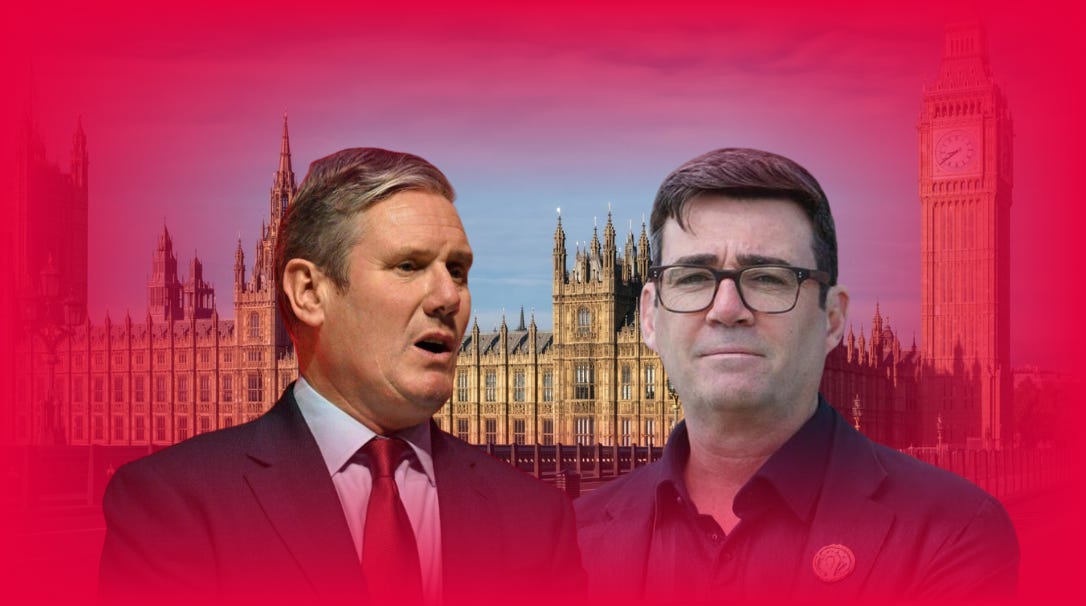
There is a very odd little civil war happening in Labour circles at the moment.
Over the last few weeks, I’ve noticed more and more posts and comments in Labour forums and political discussion boards whose main purpose seems not to be defending the Labour Government, or arguing for a particular political direction, or even making the case for Keir Starmer. They exist, instead, to have a go at Andy Burnham.
Sometimes this is dressed up as strategic seriousness. Sometimes it is framed as irritation with the Westminster psychodrama. Often it is just a good news story about the Government posted alongside some little non sequitur comment about his opponents, like “Andy Burnham isn’t fit to lick Keir’s boots”, or a dark muttering about treachery, ambition, or betrayal - all the other words people reach for when politics becomes less about judgement than court etiquette.
I find this baffling.
Not because Starmer has no case to make. He absolutely does. There are serious Labour achievements to defend: the Employment Rights Act, the increase in the National Living Wage, Great British Energy, the Renters’ Rights Act, the scrapping of the Rwanda scheme, and the return of passenger rail services to public ownership. Those are not trivial things. They are the kind of things Labour members should be willing to defend, and the kind of things the Government should be much better at explaining.
The problem is not that Starmer has done nothing. The problem is that politics is not a university course in which policy delivery is marked against a neat little assessment rubric. Voters are allowed to dislike a Prime Minister who has passed good legislation. They are allowed to feel that the country still does not work. They are allowed to conclude, fairly or unfairly, that the Government does not speak to their lives. And at the moment, the available evidence is grim: Labour has taken a severe beating in every poll since 2024, Reform is miles ahead in the national polls, and Starmer’s personal ratings remain at Liz Truss levels of dire.
That is frustrating. It’s unfair. But it is not irrelevant.
This is the lesson Labour members should have learned from the Corbyn years, if nothing else. Personal loyalty to a leader is not the same thing as political seriousness. Nor is it evidence of moral fibre to keep insisting that the public must be wrong until the public, with weary impatience, removes the opportunity to insist on it any longer.
There is also a more immediate problem. Andy Burnham is not a hostile columnist, a freelance leadership plot, or a spectral threat haunting the fevered imaginations of Starmer’s supporters. He is Labour’s candidate in a high-profile by-election.
The party has already made its choice. It could have tried to block him again. It did not. The NEC had previously blocked Burnham from standing in Gorton and Denton; in Makerfield, it approved his route to selection, despite the same obvious issue that if he wins he is immediately disqualified from the Greater Manchester mayoralty, triggering a mayoral by-election.
That tells us something. Perhaps Starmer wants this contest? Perhaps he thinks it is better to have Burnham inside the tent than outside it. Perhaps he believes the party has no credible way of keeping him out without looking absurd. Perhaps he thinks a win in Makerfield shores up Labour, while a loss would wound Burnham. Whatever the calculation, it has been made.
Which makes the internal attacks stranger still. If Burnham loses, that is not just a defeat for Andy Burnham. It is another Labour defeat. It is another Reform advance. It is another headline about a Government unable to hold together its old heartlands. It is another piece of evidence for everyone - Left and Right alike - already saying that Labour is finished.
And for what? The emotional satisfaction of proving, in public, that some Labour members dislike the Labour candidate?
Have a look at the kind of print going out in Makerfield right now. I’ve attached two examples - one from Labour, one from Reform.
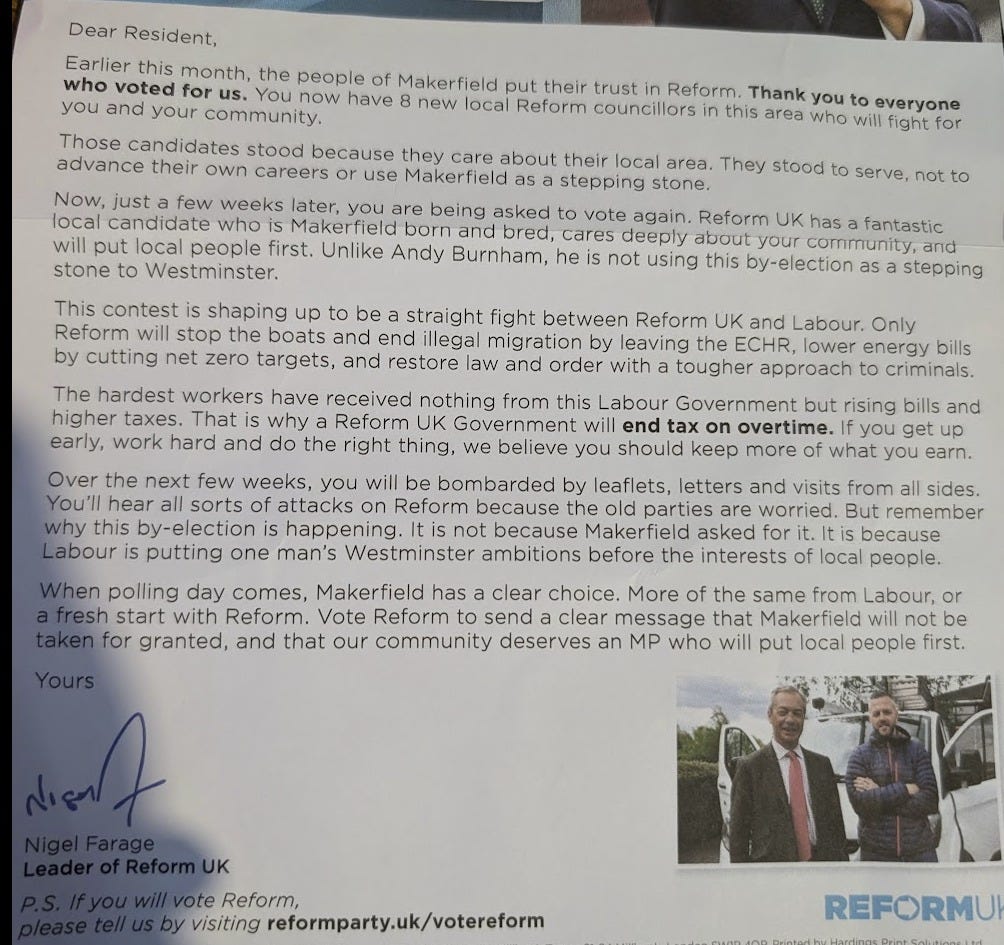
Reform’s letter is from Nigel Farage. It attacks the government, attacks Burnham, talks about boats, net zero, the ECHR, tax, crime and Westminster ambition. It claims that Makerfield needs a local person who will put the area first - but doesn’t even bother to name their candidate!
This is an extraordinary thing, really. A parliamentary by-election in which the would-be MP is treated almost as an administrative detail. The brand is Farage. The enemy is Labour. The target is Burnham. The candidate is somewhere behind the curtain, presumably waiting to be properly introduced once the vibes have done their work.
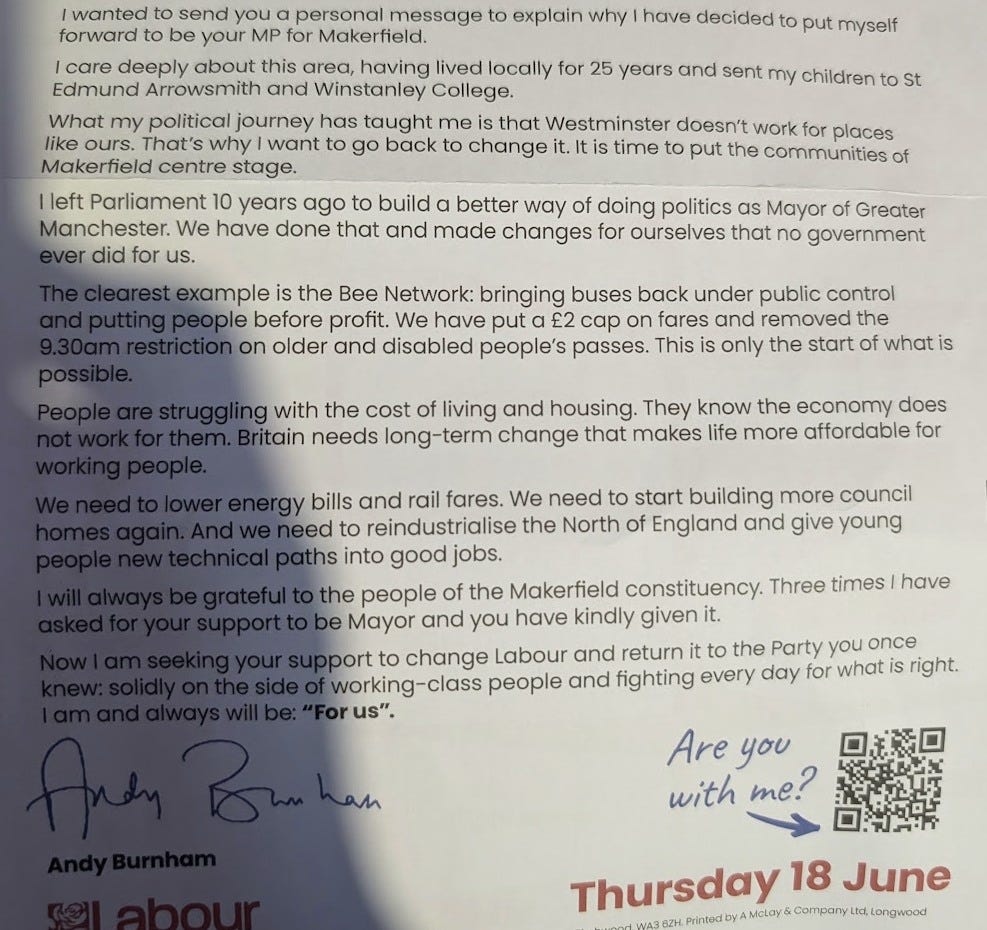
Labour’s letter, by contrast, is from the candidate. It talks about Makerfield. It talks about Burnham’s local connections. It talks about his record in Greater Manchester. It talks about his interests and plans; energy bills, rail fares, council housing, reindustrialising the North, and technical routes into good jobs.
It does not mention Reform. It does not mention Farage. It does not spend its limited space calling the other side names. This is a small thing, perhaps, but a revealing one. Reform accuses Labour of making the contest about attacks and Westminster ambition, while sending a leaflet from its party leader attacking Labour and Andy Burnham. Labour sends a leaflet from its candidate, simply making the case for what he has done and what he wants to do.
Set aside, just for a moment, the looming leadership question. Starmer clearly did when he chose not to push the NEC to repeat the Gorton and Denton decision. The immediate question is much simpler.
Labour members can have the argument about Starmer and Burnham after polling day. They almost certainly will. They may have it with spreadsheets, WhatsApp briefings, anonymous quotes, soft launches, hard launches, triangulated outriders and all the other grim ceremonial objects of internal Labour politics.
But right now, Andy Burnham is the Labour candidate in Makerfield. Reform is trying to beat him. And every Labour supporter who spends this by-election trying to undermine him is not defending Starmer. They are helping Nigel Farage make Labour look divided, bitter and unserious.
That is not loyalty. It is factional self-harm with a red rosette pinned to it.