

There is a familiar complaint that we live in a materialistic society. It is not hard to see why people say this. We buy too much, waste too much, upgrade too often, confuse novelty with improvement, and let price perform the moral and aesthetic labour that judgement used to do. We are surrounded by things, encouraged towards things, advertised things, promised things, judged by things, distracted by things, and, in the final indignity, sometimes asked to review the packaging in which those things arrived.
This complaint is not wrong. It is just incomplete.
The problem with our society is not that we care too much about material things. In many ways, we do not care about them nearly enough. We acquire them, use them, photograph them, compare them, discard them, replace them, and occasionally store them in cupboards until they become archaeological evidence of some previous version of ourselves. But we rarely look at them for long. We rarely ask what they are, how they were made, what they do to us, what kind of attention they deserve, or what kind of life they imply.
We are not too materialistic. We are not materialistic enough.
Or, more precisely, we are hasty materialists. We move through the material world with the appetite of collectors and the attention span of browsers. The object is not allowed to be itself for long. It becomes a purchase, a signal, a lifestyle choice, a productivity aid, a prop, a guilty pleasure, a status anxiety, a regret, a replacement, an item in the basket. Then the basket empties, and we begin again.
This is not an argument for buying more things. Heaven knows the economy has enough people making that case already, often with suspiciously good lighting and a discount code. It is almost the opposite. If we paid better attention to material things, we might become less desperate for the next one. We might notice the difference between value and price, between pleasure and novelty, between use and accumulation. We might begin to see that the world is not more fully possessed when it is consumed quickly.
The question is not whether material things matter. Of course they matter. We are material beings. We live in bodies. We eat, wear clothes, use tools, inhabit rooms, travel through streets, play games, read books, break mugs, repair tables, keep old jumpers for reasons we cannot quite justify and would slightly resent having to explain. Human life is not a concept floating above the world. It is lived through surfaces, textures, weights, smells, tools, habits, landscapes and objects.
The better question is what kind of attention those things receive.
A Basket of Fruit Against the Feed
Still life is an odd phrase. Life, notoriously, does not sit still. It grows, bruises, rots, ripens, leaks, wrinkles, blooms, splits, collapses, gathers dust, stains the tablecloth and attracts flies. To call it still is almost a contradiction. Yet that contradiction is part of the point. Still life is not life without movement. It is life arrested long enough to be seen.
This is why Caravaggio’s Basket of Fruit remains such a useful image for thinking about material attention. Painted around the turn of the seventeenth century and now in the Pinacoteca Ambrosiana in Milan, it is often described as a prototype of the still-life genre - often considered to be the first genuine western still-life painting since the fall of Rome. It gives us a wicker basket, fruit and leaves rendered with extraordinary realism, placed against a plain background. Nothing much is happening. And that’s kind of huge for the time - this is the first painting in the western world, anno domini, which abandons every obvious figure of grand religious narrative and places the sole focus on a mere object. There is no martyrdom, no annunciation, no king, no saint, no hero pointing nobly towards the middle distance. Just fruit. Just leaves. Just a basket.
But ‘just’ is doing an enormous amount of work there.
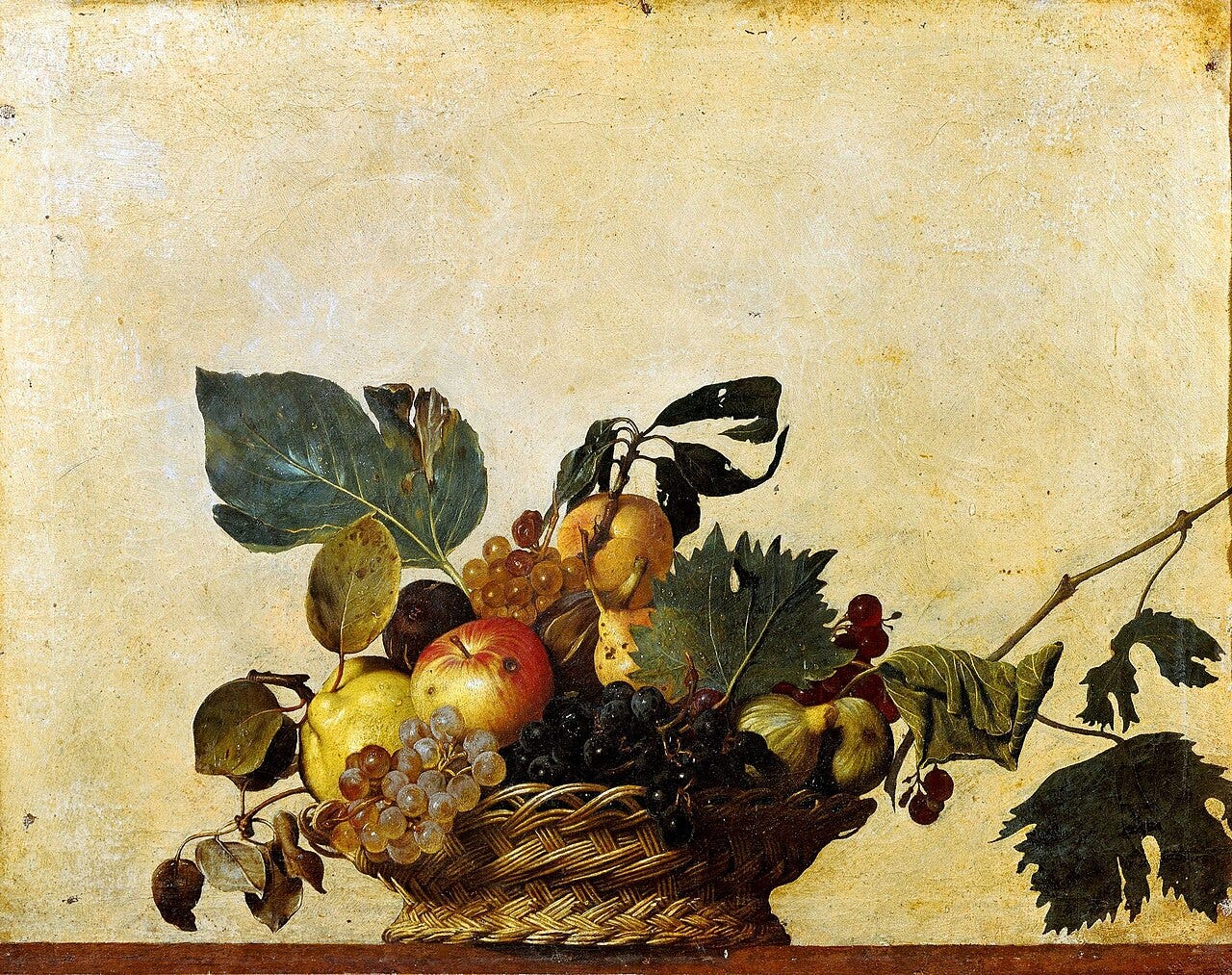
A basket of fruit sounds humble until one actually looks at it. The fruit is not a stock symbol of abundance. It is blemished. Leaves curl and brown. Some of the produce looks heavy with ripeness, some already carrying signs of damage and decay. The painting is not merely saying that fruit exists, which would be a fairly limited achievement even by the standards of art criticism. It is asking the viewer to attend to the fact that material pleasure is never separate from time. Ripeness is already on the way to rot. Abundance already contains loss. The beautiful thing is beautiful partly because it cannot remain as it is.
That is one reason still life is so often misunderstood as minor art. It can look modest because its subject matter is modest. Fruit, glassware, flowers, bread, fish, books, a skull, a jug, a peeled lemon, a half-empty cup. Yet the modesty is deceptive. Still life takes the objects that usually sit at the edge of attention and moves them to the centre. It does not need to invent grandeur because it has discovered that grandeur was already there, waiting in the bowl.
There is something quietly defiant about this. The world is always trying to organise our attention hierarchically. Look at the spectacle. Look at the grand event. Look at the famous person. Look at the newest thing, the latest thing, the next thing, the thing everyone is currently pretending not to be tired of. Still life refuses the hierarchy. It says: look here. Look at the apple. Look at the knife. Look at the vase. Look at the bruise.
This is not escapism. It is a discipline.
Tate’s description of still life captures the tension neatly: the genre can celebrate material pleasures such as food and wine, but it can also warn of the brevity of those pleasures and of life itself. That is exactly what makes it so useful against our own culture of consumption. It neither rejects material pleasure nor surrenders to it. It pays attention to it.
And attention, properly given, changes the moral texture of pleasure.
The World Is Not Content
The modern problem is not that we enjoy things. Enjoying things is one of the more defensible human activities. The problem is that we are increasingly encouraged to process things before we experience them.
A meal becomes a photograph. A book becomes an aesthetic accessory. A holiday becomes evidence of having been on holiday. A concert becomes a clip. A walk becomes a route map. A conversation becomes a post. A hobby becomes a personal brand. A private enthusiasm becomes, with alarming speed, a content strategy.
This does not mean every photograph is shallow, every post is fake, or every attempt to share pleasure is secretly a moral collapse. That would be silly, and worse, it would be the sort of joyless argument that makes people quite reasonably suspect that the critic’s real objection is other people having fun.
There is pleasure in sharing things. There is pleasure in saying look at this, I saw it and thought of you. There is pleasure in recording a meal, a place, a game, a view, a joke, a stupidly expensive coffee that came in a cup apparently designed by someone who has heard rumours of handles but remains ideologically opposed to them.
The trouble begins when the record of the experience becomes the purpose of the experience. The object is then no longer encountered. It is harvested. Its value lies not in its presence, but in its usefulness as evidence. The world becomes a set of prompts: document this, optimise this, display this, monetise this, archive this, move on.
This is hasty materialism at its purest. It is not the love of things. It is impatience with them.
A society that truly loved material things would not treat them as disposable at the first sign of inconvenience. It would not design objects to fail, furniture to be replaced, clothes to be worn twice, phones to become socially obsolete before they are technically useless. It would not reduce food to fuel one moment and lifestyle performance the next. It would not teach people to think of every object as either an upgrade or clutter.
Our culture does not value the material world too highly. It values possession, novelty and signalling too highly. Those are not the same thing.
To value the material world is to notice dependence. It is to understand that objects come from labour, extraction, craft, transport, design, repair, maintenance and waste. It is to see that the cheap thing is not cheap because it cost little to make, but because the cost has been displaced somewhere else. It is to recognise that a £10 object and a £1,000 object are not simply different quantities of worth. They are different stories about desire, status, scarcity, labour, branding, utility and power.
The market is very good at pricing things. It is much less good at teaching us how to value them.
That distinction matters because the moral critique of consumerism often sounds as though the virtuous person should float above material life altogether. Do not want things. Do not take pleasure in things. Do not be seduced by surfaces. Seek higher things. This is sometimes useful advice, particularly if the thing in question is a £600 air fryer with Bluetooth capability, but as a general philosophy it will not do.
We do not become better by pretending we are not embodied. We do not escape materialism by despising the material world. We escape bad materialism by practising better materialism: slower, more attentive, more grateful, more sceptical of novelty, more aware of cost, more capable of pleasure because less desperate to convert pleasure into proof.
Loot, Clutter and the Art of Looking
This is where games become unexpectedly useful.
Games are full of things. They may be digital things, but they are things all the same within the logic of play: weapons, armour, food, potions, books, keys, coins, crafting materials, furniture, letters, bottles, rugs, statues, bones, flowers, pointless decorative plates, mysterious glowing rocks, and approximately nine thousand red explosive barrels. If games have taught me anything, it is that digital civilisation would collapse without barrels.
Yet games often train us to treat things instrumentally. The object is loot. It has stats. It can be equipped, sold, scrapped, upgraded, combined, consumed, socketed, enchanted, dismantled, stored, or ignored because it is grey-tier rubbish and we have become, in that moment, little digital aristocrats. A world that may have taken artists hundreds of hours to assemble rapidly becomes a series of lightning-fast interactions: take, sell, improve, complete.
This is not a complaint about mechanics as such. Games need systems. Loot can be fun. Progression can be satisfying. There is an ancient and noble pleasure in finding a sword with bigger numbers than the previous sword, especially if the new sword is also on fire. The issue is not that games offer instrumental relationships with objects. The issue is that instrumental attention can crowd out every other kind.
There are games, and moments within games, that resist this.
Think of the domestic interiors in Red Dead Redemption 2, cluttered with the textures of a life nobody will explain to you because the explanation is not the point. Think of the melancholy accumulation of objects in Disco Elysium, where the world feels stained by politics, memory, poverty and failed grandeur. Think of the item descriptions in Dark Souls, where a ring or scrap of armour can feel like a fragment of a ruined civilisation rather than a stat adjustment wearing a hat. Think of the lovingly arranged nonsense in any Bethesda game: walk into a room and you’ll find books, plates, tankards, cheese wheels, all useless and yet somehow essential to the feeling that the place existed before you arrived to rob it.
The best environmental storytelling often works like still life. It does not merely decorate the world. It asks us to infer life from arrangement. The cup beside the bed, the chair angled towards the window, the bloodstain near the door, the child’s toy in the ruin, the meal abandoned halfway through. These things are not important because the quest marker says so. They are important because they produce the sensation of a world with weight.
But games also reveal how fragile this kind of attention is. Place a beautifully rendered apple on a table, and half the players will ignore it. Give it a minor healing effect, and they will strip the orchard bare like locusts with inventory management issues.
Again, this is not a moral failing. It is a design question. Games tell players how to look. If the world rewards only extraction, players will learn to extract. If every object is either useful or useless, players will divide the world accordingly. If every location is a checklist, players will develop checklist vision. The eye goes where the system sends it.
This is why the most interesting games often create moments where usefulness falters. A view that offers no reward. A room whose meaning is atmospheric rather than mechanical. A piece of clutter that cannot be picked up. A meal that exists only to imply ordinary life. A landscape that does not lead efficiently to the next objective. These moments can frustrate the completionist part of the brain, which is frankly good for it. That part of the brain has had things its own way for too long.
The point is not that every game should become a contemplative art installation in which the player spends forty minutes appreciating a spoon. There are limits, and one of them is probably the spoon. The point is that games, like still life, can remind us that attention is a form of relation. To see an object only as a means is to miss some part of its reality. To see a world only as content is to become incapable of inhabiting it.
Better Materialism
There is a social politics here, though it is not quite the one we usually reach for.
The obvious critique says: we consume too much, therefore we should consume less. This is true, or at least true enough to be getting on with. But it is also too thin. People do not only consume because they are greedy. They consume because they are anxious, bored, lonely, tired, pressured, rewarded, targeted, habituated and occasionally because the old kettle has started making a noise like a haunted tractor. A serious critique of consumption has to understand desire rather than simply denounce it.
Still life helps because it does not begin by denouncing pleasure. It begins by looking at it. It lets the peach be desirable, the glass shine, the flower bloom, the tablecloth fold. Then it lets time enter the picture. The fruit bruises. The flower wilts. The skull waits. The candle gutters. The object is not condemned; it is placed back inside mortality.
That is a better model for thinking about material life than either consumerism or puritanism. Consumerism says the thing will complete you, at least until the next thing arrives. Puritanism says the thing is a trap, and you would be better off wanting nothing. Still life says: the thing is real, the pleasure is real, the decay is real, and your attention is part of what gives the encounter its meaning.
This matters because attention is one of the few forms of resistance still available in ordinary life. Not resistance in the grandiose sense. Looking closely at a mug is not going to overthrow capitalism, and anyone who tells you otherwise is probably about to sell you a course. But attention can interrupt the habits on which bad materialism depends. It can make us slower to replace, quicker to repair, less impressed by branding, more grateful for use, more alert to waste, more interested in craft, less easily bullied by novelty.
The more closely you look at things, the harder it becomes to treat them as disposable.
That does not mean becoming precious about every object. Some things are badly made. Some things break. Some things deserve the bin, including every novelty kitchen gadget designed to solve a problem that could be addressed with a knife and a modest amount of courage. But the general habit matters. A person who pays attention to material life may own fewer things, not because they have transcended desire, but because they have learned to desire more carefully.
There is a politics in that, but also an ethics, and perhaps an aesthetics too. The point is not to moralise the contents of the cupboard. It is to recover the possibility that ordinary things might be worth sustained attention before they are replaced by ordinary things in a different colour.
Going Nowhere in Particular
Near the end of my old first-draft attempt at this argument, in the comments section somewhere, I reached for Nan Shepherd, which I think was one of the better instincts of the comment. In The Living Mountain, Shepherd writes about the Cairngorms not as scenery to be consumed or conquered, but as a place to be known through repeated, bodily, attentive presence.
‘Yet often the mountain gives itself most completely when I have no destination, when I reach nowhere in particular, but have gone out merely to be with the mountain as one visits a friend with no intention but to be with him.’
That is a profoundly unfashionable way of approaching anything.
We are trained to prefer destinations. Achievements. Views. Summits. Posts. Purchases. Completions. The startling pinnacle, the scenic payoff, the thing one can point to afterwards as proof that the experience was successfully checked off the bucket list. Shepherd’s point is not that destinations are bad. It is that a destination can become a way of not seeing the path.
The same is true of objects. We can own without attending, consume without enjoying, collect without caring, play without inhabiting, travel without arriving. We can move through a world thick with material presence and barely touch it.
Still life asks something slower of us. So do the best games, the best walks, the best meals, the best rooms, the best books, the best conversations with objects whose usefulness is not immediately obvious. They ask us not merely to acquire the world, but to notice it.
Contemplate the hum of the car engine the next time you hurtle down the road, late to pick up the kids. Notice the chatter of passers-by as you walk through a crowd on your way to work. Breathe in the still night air and look up at the silent stars as you walk home after a night out on the town. Look again at the fruit in the fruit bowl. Look at the object on your desk, the worn edge of the table, the controller in your hand, the book you keep meaning to read, the cheap pen that somehow writes better than the expensive one, the jumper you should probably throw away but do not, because it has become part of the private museum of yourself. Consider what it is, how it came to be there, the detail of how it was put together, and try to appreciate the effort, the beauty, the complexity of the object.
The details are not always easy to see. That is half the point.
And if you miss them, you are not rising above the material world.
You are missing the world.