

There is a very funny theory of artistic decline in which Fable was not wounded by clumsy design, overpromising, tedious navigation, anaemic combat, awkward co-op, loading screens, cancelled spin-offs, studio closure, or the general difficulty of sustaining a whimsical British action-RPG franchise inside a modern platform-holder’s release strategy. No. The culprit, apparently, was tofu.
This is not quite as invented as it sounds. Fable, or at least Fable II, really did attach moral value to food. Eating tofu increased purity; eating meat nudged the player towards corruption. PETA really did praise the game for this, handing it a Proggy Award for being animal-friendly. In the grand museum of silly gaming controversies, this is not even the strangest exhibit. It is, however, one of those facts that sounds as though it has been retold so many times that it has become a different story. PETA did not kill Fable. If anything, PETA appears to have mildly embarrassed it by applauding from the sidelines.
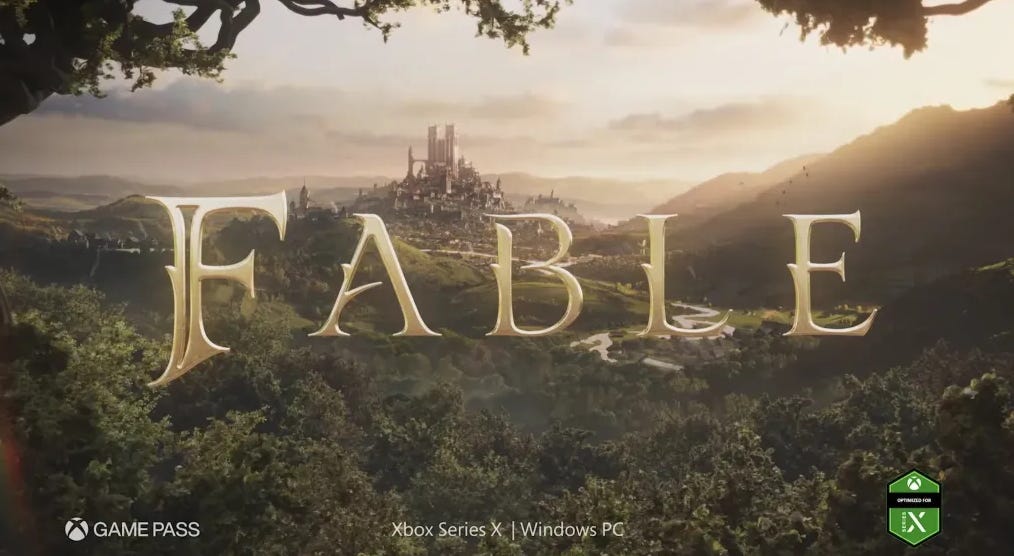
The occasion for all this, naturally, is the new Fable, currently due in February 2027. The exact object of anxiety varies depending on where you look. Some people dislike the art direction. Some are suspicious of the shift away from the old morality system. Some simply mistrust any revival of a beloved franchise after a long absence, which is not an unreasonable instinct. But beneath the ordinary caution there is a more familiar and more tedious claim: that the old Fable was somehow killed by wokeness, DEI, sensitivity, political correctness, animal-rights meddling, or whatever label has been chosen this week for the general suspicion that somebody, somewhere, has been allowed to consider the feelings of another person.
This is a bad explanation. It is not bad because politics never damages art. It is bad because it is a substitute for criticism. It offers a suspect before it has found the body.
The true thing in the wrong argument
The serious version of the anti-woke complaint is worth taking seriously, at least briefly. Art can absolutely be damaged by nervousness. It can be damaged by committee thinking, brand management, reputational anxiety, moral flattening, or the dull sense that every character has been made to pass through the same HR induction before being allowed on screen. A story can fail because it is too frightened of ambiguity. A game can fail because it mistakes player freedom for a risk to be managed. A television drama can fail because it wants the audience to endorse its values before it has earned their attention.
There are works now, as there have always been works, that confuse righteousness with quality. They give us characters who do not argue so much as represent positions. They avoid drama because drama would require the possibility that the wrong person might be interesting. They treat virtue as a casting decision rather than a conflict, a cost, a temptation, a discipline, or a tragedy. There is a genuine criticism to be made of art that becomes so afraid of being misunderstood that it forgets to be alive.
But this is not the same claim as wokeness kills art. The difference matters. One is an argument about execution. The other is an incantation.
The issue is not whether art should contain politics. Art is always carrying values, even when it pretends not to. The issue is whether those values have been transformed into form: into structure, character, mechanics, rhythm, image, consequence, contradiction, tone. Politics can be sermon. It can also be architecture.
Fable was always political, because Fable was always moral
The odd thing about applying this complaint to Fable is that Fable was never a neutral franchise. It was not a pristine little folk tale minding its own business until ideology barged in wearing a lanyard. It was always a game about visible morality. It made goodness and corruption physically legible. It turned ethics into skin texture, diet, reputation, property, sex, taxation, marriage, cruelty, sacrifice, spectacle and occasionally horns.
This was not subtle. Fable was not exactly Dostoevsky with fart emotes. Its moral universe was broad, silly, theatrical and often incoherent. But that was also part of its charm. It wanted moral choice to be legible at the level of pantomime. The saint glows. The villain mutates. Your diet, rent policy, cruelty, generosity and social behaviour become part of a visible civic mythology. Albion was always a world where private choices became public theatre.
So when people complain that Fable became political because tofu was pure, they are not really complaining about the arrival of politics. They are complaining about a specific moral coding that now feels, to them, politically suspect. The game was allowed to moralise about murder, greed, selfishness, public duty, sexuality, marriage and class. But tofu? Suddenly Albion has fallen to the commissars.
This is the sleight of hand behind a great deal of anti-woke cultural criticism. It does not object to politics in art. It objects to politics it recognises as politics.
A game in which kingship, property ownership, public reputation and visible sin structure the player’s experience is already political. It may not be sophisticated politics. It may not be coherent politics. But it is certainly not apolitical. The old Fable was not some pure domain of prelapsarian play before the serpent of DEI entered the garden. It was a moral cartoon. That was rather the point.
Fable 3 was not assassinated by tofu
The problem with Fable III was not that it contained ethical ideas. The problem was that it was, on the most ordinary level, annoying.
The AngryJoeShow review from 2011 is useful here not because it is subtle (it is not especially trying to be), but because it is so firmly about the experience of playing the game at the time of release, rather than looking back on it through your spectacles of choice. The complaints made against it in 2011 are not about diversity targets or vegan propaganda. They are about the Sanctuary replacing usable menus; the lack of a proper map; constant loading screens; meaningless co-op; DLC restrictions; weak customisation; broken or unbalanced combat and the overpowered magic system; the lack of challenge; degraded NPC interactions; weapon morphing that did not work as advertised; empty crates; short story length; anticlimactic boss fights; and the general sense that the game had made everything slower, thinner and less satisfying.
That is a boring explanation, but it is also the better one. Boring explanations often are. A game can have gorgeous environments and still fail because it makes the player fight the interface. A game can have charm and still fail because its systems do not reward attention. A game can promise consequence and still fail because its choices are mechanically shallow. A game can let you be king and still fail if the route to doing anything useful runs through a tiresome sequence of rooms, podiums, button holds and loading screens.
You could remove every moral point from every vegetable in Albion and the Sanctuary would still be there, waiting to waste your afternoon.
This matters because games are not just scripts with graphics attached. They are systems of action. A bad film may be dragged down by dialogue, pacing or performance; a bad game may be dragged down by the feeling of moving through menus, the friction of repetition, the absence of tension, the mismatch between promise and mechanic. When criticism ignores that, it ceases to be criticism of games and becomes criticism of vibes.
This is why the Fable III example is so revealing. The anti-woke account does not explain the experience of playing the game. It explains the experience of reading a culture-war argument into the ruins afterwards.
Politics as mechanics
To take another game from broadly the same era, consider Dishonored, released almost exactly two years later. The game (and subsequent series) does not merely contain a moral preference for non-lethal play as a line of dialogue or a scolding end screen. It builds that preference into the world. Violence changes the atmosphere depending on its lethality. Higher chaos alters the city, affects endings, shifts the sense of social collapse and makes the player’s behaviour part of Dunwall’s disease. It is not simply that the game says killing is bad - that would be a boring lecture. It asks a much more interesting artistic question about world design; what kind of city is produced when one more body can always be justified?
Was that woke? It would be easy, in the lazier corners of the internet, to make it sound so. Here is a game that discourages impulsive lethal violence, associates bloodshed with social decay, and makes restraint not only possible but narratively meaningful. One can almost write the thumbnail now: Stealth Classic RUINED by WOKE Pacifist Agenda. The only reason this sounds absurd is that Dishonored is too good, too stylish and too mechanically rich for the complaint to stick easily.
That is the point. When politics is well integrated, people often stop calling it politics. They call it atmosphere, consequence, theme, tone, worldbuilding, tragedy, satire, character. When politics is badly integrated, or when a work is bad while also containing politics, the politics becomes the obvious thing to blame.
This is not unique to games. Russell T Davies has built whole dramas around queer life, homophobia, grief, desire, family, shame, sex, public panic and the violence that grows in the gap between private fear and social permission. Queer as Folk was not apolitical. Cucumber and Banana were not apolitical. It’s a Sin was not apolitical. His recent Tip Toe is a drama fundamentally about the politics of rising hatred, misinformation, and online rage in a more frightening public climate.
One can criticise any of these works on artistic grounds. One can argue that a scene is too broad, a character too schematic, a plot too engineered, a monologue too direct, an ending too cruel, an image too obvious. But to say that politics has killed the art would be bizarre. The politics is not pasted over the drama. It is the matter from which the drama is made.
The better distinction is not political versus apolitical art. It is digested versus undigested politics.
The anti-woke alibi
The phrase wokeness kills art is powerful because it is lazy in a very satisfying way. It reduces many possible failures to one cause. Commercial caution? Wokeness. Bad writing? Wokeness. Underpowered mechanics? Wokeness. Corporate consolidation? Wokeness. A sequel made without the original conditions that allowed the first work to succeed? Wokeness. The slow entropy of a franchise whose symbols have outlived its creative purpose? Wokeness. Three loading screens to find the right bit of the inventory menu? Somehow, still wokeness.
This is criticism as conspiracy board. Everything is connected because the theory requires it to be connected.
It is not that culture-war readings are always irrelevant. Games, films and television are made within institutions, markets and moral climates. Developers and writers do make choices under pressure. Publishers do worry about backlash. Audiences do fragment into ideological markets. Studios do sometimes sand down awkwardness in the hope of pleasing everyone, which is a reliable way of pleasing nobody. Political incentives exist. Social incentives exist. Commercial incentives exist.
But the anti-woke account collapses all of that into a morality play. It is not interested in how art is made. It is interested in how art can be recruited as evidence.
The result is a kind of criticism that has become weirdly incurious about craft. It can tell you that a female character’s jawline proves civilisational collapse, but not whether a combat loop has tension. It can identify the alleged ideology of a trailer from seventeen pixels and a haircut, but not ask whether the quest design has momentum. It can rage at inclusive casting while ignoring pacing, structure, animation, level design, sound, mise-en-scène, performance, system balance and the thousand other things by which art either lives or dies.
This is especially perverse in games, because games are so obviously formal objects. They are not just about what they represent. They are about what they ask us to do, how often, at what cost, with what feedback, under what conditions, and with what consequences. A game can be reactionary in story and progressive in mechanics. It can be progressive in story and exploitative in economy. It can tell you that freedom matters while refusing to let you jump over a waist-high fence. Games embarrass simple ideological readings because they are made of too many interacting parts.
That does not stop people trying.
When politics really does damage art
There is a trap here, and it is worth avoiding. The answer to bad anti-woke criticism is not to insist that politics can never damage art. Of course it can. Politics damages art when it prevents conflict. It damages art when characters become delivery systems for approved conclusions. It damages art when the audience is never trusted to infer. It damages art when a work is more interested in signalling its moral hygiene than in testing its moral imagination.
This can happen from the left, the right, the liberal centre, the nationalist fringe, the corporate brand department, the pious legacy franchise custodian and the prestige dramatist with one eye on awards season. Bad political art is not owned by any one faction. Propaganda can be dreary in many directions.
But again, the issue is not politics as such. The issue is artistic digestion. A work has to metabolise its values. It has to turn them into living problems. It has to allow difficulty. If a game wants to explore violence, it cannot simply wag its finger every time the player uses the elaborate violence toys it has spent half the budget creating. If a drama wants to explore prejudice, it cannot make every bigot an idiot and every victim a saint. If a fantasy world wants to explore monarchy, class, corruption, public duty and moral visibility, it has to do more than assign purity points to lunch.
The criticism of bad political art should be more demanding, not less. It should ask whether the politics has become dramatic, mechanical, aesthetic, comic, tragic, frightening or playable. It should ask whether the work has found form for its values. It should ask whether the audience has been given an experience or merely a position.
That is a more useful standard than counting the number of suspiciously modern moral assumptions and declaring the corpse woke.
The politics were not the problem. The criticism was.
The saddest thing about the anti-woke reading of art is that it makes people worse at noticing what is actually wrong. It flattens failure. It deprives bad work of the dignity of being bad in specific and interesting ways.
Fable III is not a perfect object of nostalgia. It is not a fallen temple desecrated by tofu. It is a game whose artistic direction, humour and setting could not compensate for frustrating design, thin systems, and a suffocating interface that turned what could have been a good game into a tiresome chore. Its failure is not mysterious. You do not need a theory of cultural capture to explain why players dislike being made to take a detour through a magical changing room every time they want to do something simple.
The wider lesson is not that progressive politics guarantees good art. It plainly does not. Nor is it that anti-woke criticism never identifies real problems. Sometimes it stumbles into them, usually by accident, before misnaming them. The lesson is that politics is a poor substitute for criticism when it becomes a single-cause explanation for everything one dislikes.
Art fails in many ways. It fails through cowardice, indulgence, incoherence, laziness, bad structure, commercial pressure, overproduction, underdevelopment, tonal collapse, mechanical friction, poor pacing, weak endings, bad acting, timid direction, misplaced faith in lore, sequel exhaustion, fan service, algorithmic anxiety and sometimes because the person in charge simply did not know when to stop. Occasionally, yes, it fails because its politics have been badly handled.
But if every failure is explained by the same enemy, you are no longer doing criticism. You are sorting evidence for a prior belief.
The new Fable may be good. It may be terrible. It may discover a new way to preserve the old series’ absurd moral theatre, or it may sand the whole thing down into a politely eccentric brand revival. It may contain good politics badly handled, bad politics elegantly handled, or almost no politics beyond the usual fantasy assumptions about heroes, villains, power and destiny. The only honest thing to do is judge the work when it exists.
Until then, we might at least retire the idea that tofu killed Albion.
Wokeness did not invent loading screens. And if the next Fable fails, the first place to look will not be the vegetable aisle.